
Lenovo USB-C 7-in-1 Hub Review
Simplify tech chaos with the Lenovo USB-C 7-in-1 Hub: connect devices effortlessly! Discover elegant design and plug & play ease for your savvy adventures.
Have you ever been caught in that maddening scenario where you’re juggling various cords and adapters, trying to connect an array of devices and utterly failing to look like the tech-savvy wizard you claim to be? ENTER — in bold letters and without the exclamation point because we’re sophisticated here — the Lenovo USB-C 7-in-1 Hub. This is that rare gizmo that promises to give a respite from the erratic dance of plugging in, unplugging, and risking tangling yourself up like a kitten in a Christmas yarn catastrophe.
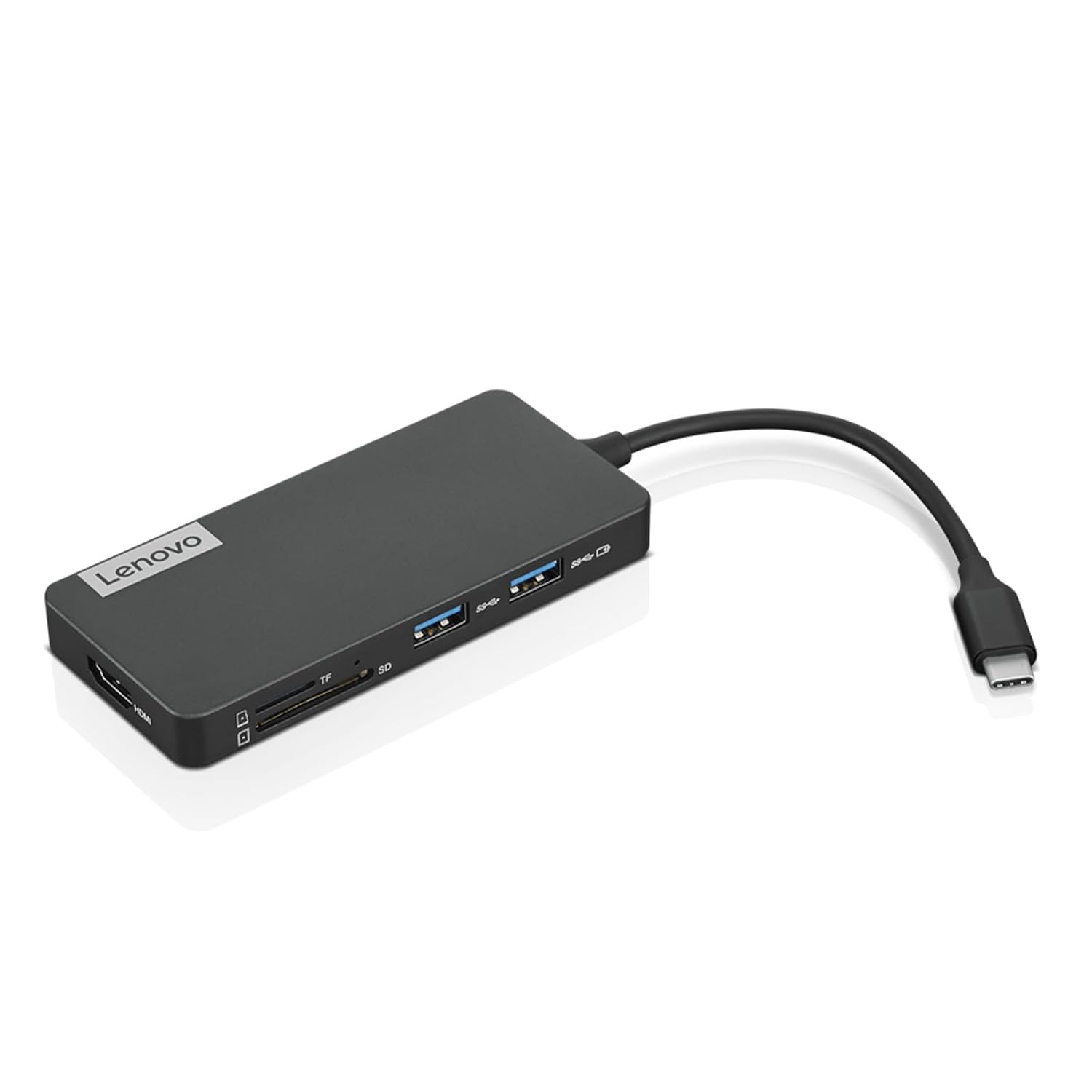

The Riddle of Connectivity
Oh, connectivity. It’s what keeps us up at night, pondering how we might one day be truly rid of all the unnecessary wires and connectors. To the maker of this USB-C hub, I say, bless you for trying to simplify life with a single, sleek tool that offers seven distinct possibilities. To understand its glory, let’s take a closer look.
| Feature | Details |
|---|---|
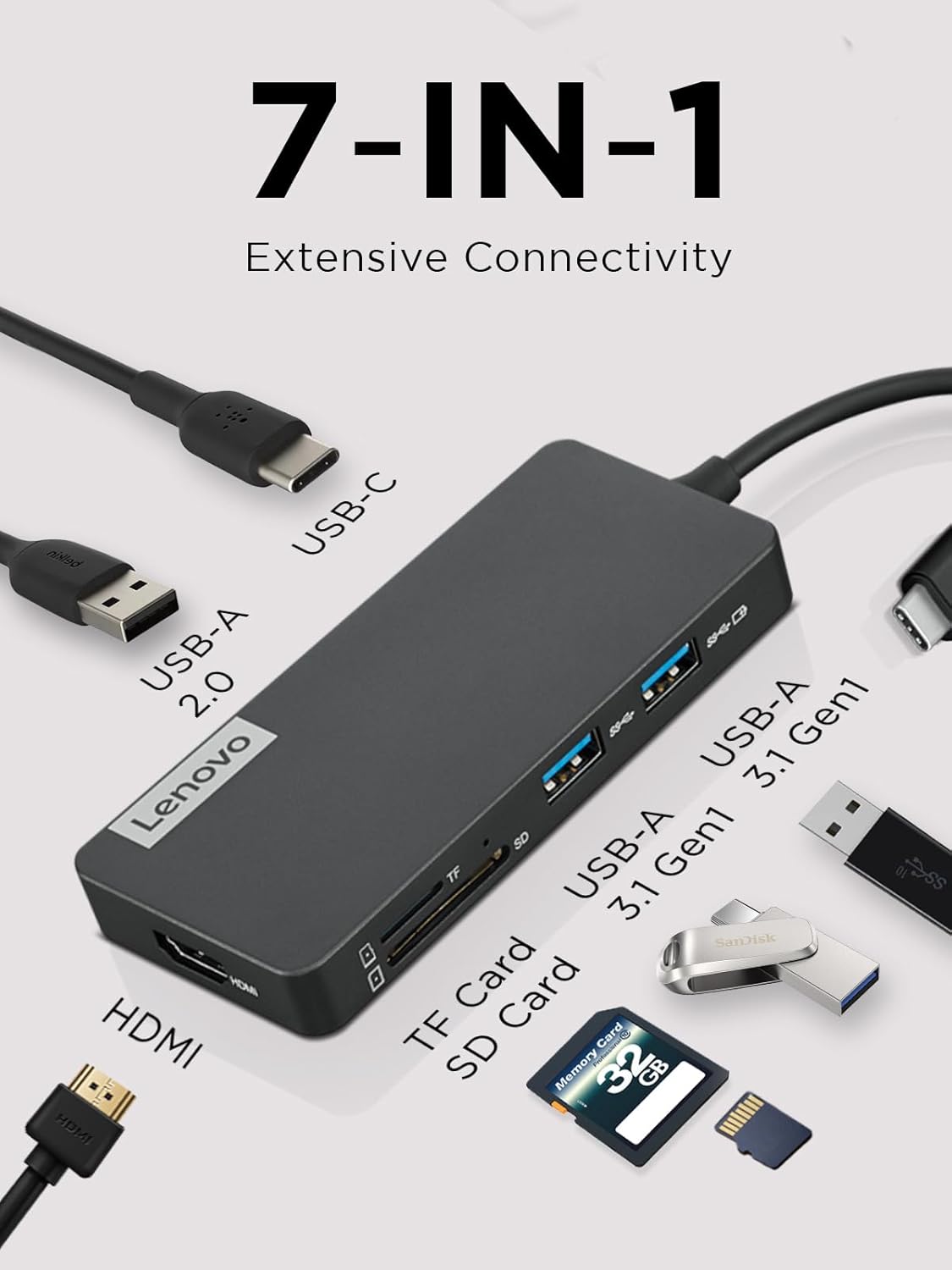
| Port Options | HDMI, 3 USB-A, 2 SD/TF Card Readers, USB-C Power Pass-Through |
| Resolution Support | 4K via HDMI |
| Design | Slim, compact, travel-friendly |
| Power | USB-C power pass-through (with an optional 45W/65W USB-C power adapter) |
| Functionality | Plug & Play, no driver installation required |
The Great HDMI Expedition
Plug in, look sophisticated, connect to an external display, and suddenly you’re a PowerPoint Picasso with your presentation in glorious 4K. Are you going to use it to showcase dynamic charts on growth? Or will you watch cat videos on the big screen? Both are valid uses. This single HDMI option opens a treasure chest of possibilities and possibly sacrifices the argument of who can see the screen best.
A USB-A Paradise
Three USB-A ports walk into a bar, and suddenly, it’s a party. The USB-A ports are here to prove that not everything old needs to be tossed like a pair of socks with holes. Supporting up to three legacy devices — think hard drives, printers, or that USB fan you’ve had since the Jurassic era — you can connect old-timers for delightful functionality.
Memory Lane: SD/TF Card Readers
Here’s where things get really 21st-century. The two SD/TF card readers, like trusty library assistants, will take their jobs very seriously as they transfer data from your camera’s memory card to your laptop as fast as you can say “remember when we used to develop film?” Even if photography for you is a string of smartphone selfies, you’ll feel immediately obliged to engage in more traditional photography, just to use this feature.
Pondering Power Pass-Through
Now let’s talk power, an ever-elusive element in our batteried lives. The ability to provide USB-C power pass-through is like discovering a charger in the couch cushions when your phone is at 1 percent. Just throw in a compatible 45W or 65W USB-C power adapter, and immediately your laptop becomes an artist’s canvas with a limitless palette, rather than that mundane, low-battery sloth.

Lenovo – USB-C 7-in-1 Hub – Computer Networking Laptop Accessory – Laptop Docking Station - 4K via HDMI, 3 USB-A devices, 2 SD/TF Card Readers USB-C Power Pass Through
Aesthetics of Elegance
Here we are, indulging in the beauty of minimalist design. The Lenovo USB-C 7-in-1 Hub doesn’t scream for attention, which in itself is a peculiar form of elegance in our loud world. Imagine it slipping gently into your backpack or the tote you randomly purchased on Venice Beach, and away you go. Unobtrusive, yet superbly functional — it whispers class without the unnecessary chatter.
The Ritual of Simplicity
I lament each time I need to install drivers. In a world where “plug & play” sounds like someone describing toys instead of tech, the Lenovo USB-C Hub is refreshingly straightforward. Just connect it to your laptop, and voilà, no novice-like driver installation debacles to wrestle.
Buying Bliss: Contemplating Value for Money
Now, let’s wax philosophical about value. If you pinpoint purpose and potential into this one USB-C hub, it’s like having a Swiss army knife for your digital needs. Does it mean you won’t ever need tech support again? No. (I guarantee I’d find a way to need help with this thing anyway.) But will it at times make you feel like the digital superhero you secretly aspire to be? Absolutely.
Cost-Benefit Conundrums
Financially speaking, in the kingdom of tech accessories, it’s neither the cheapest nor the most exorbitant. Somewhere in the cozy middle ground lies its price point. And who knows, on some sales day, you could snag it at a discount and tell all your friends quality never looked so affordable.
Peroration on Portability
If there were Oscars for tech accessories, portability would be the ingenue nominee everyone roots for. Imagine not fumbling in your bag in that crowded conference room or hotel lobby, for once perfectly retrieving the Lenovo USB-C 7-in-1 Hub. In that brief moment, you think, “What a time to be alive.”
Sentiments on Setup
The brains behind the hub (and I feel we’re on first-name terms by now, aren’t we, Lenovo?) insist setup shall remain delightfully pain-free. I haven’t felt such ease since sticking a sticker. Knowing tech can be that intuitive is worth writing home about.
Reflecting in Changing Times
In summation, to evaluate this gadget as merely an accessory is like calling Paris a city—it’s so much more. The Lenovo USB-C 7-in-1 Hub triumphs by transforming the chaotic into a calming symphony of order and functionality, all through a surprisingly beautiful portal of understated elegance.
Having one USB-C cable master such diverse connectivity could lead to a slow yet steady global reduction in tech-related complications, disputes over compatibility, and perhaps unwarranted swearing at inanimate objects.
So here’s to fewer tangled cords cluttering your path, and more seamless tech adventures lying ahead. I invite you: step into this brave new world where connectivity is concerned, and reflect upon it with as much zeal and amusement as the journey deserves.
Disclosure: As an Amazon Associate, I earn from qualifying purchases.
Docking Station Intelligence
The standards are confusing by design. These three panels decode what manufacturers won’t explain clearly. Applicable to every docking station.
The USB-C Confusion Matrix
The USB-C connector is the single greatest source of buyer confusion in docking stations. The physical plug looks identical whether it carries USB 2.0 at 480 Mbps or Thunderbolt 5 at 120 Gbps — a 250x difference in capability hidden behind the same shape. Manufacturers exploit this by labeling everything "USB-C compatible" without specifying which protocol runs through it. Two docks can look identical on the outside and behave completely differently once you plug them in.
The hierarchy matters because it determines everything: how many monitors your dock can drive, how fast files transfer, whether your laptop charges while docked, and whether you need third-party drivers. Here is the real capability ladder, from slowest to fastest:
The practical takeaway: if your laptop has Thunderbolt 4, buy a Thunderbolt dock. If it only has generic USB-C, verify whether it supports DisplayPort Alt Mode before buying anything with multi-monitor claims. Our buying guide walks through verification steps for every major laptop brand.
Power Delivery: What the Watts Mean
Power Delivery (PD) determines whether your docking station can charge your laptop while you work, or whether you need a separate charger cluttering your desk. The math is simple but rarely explained: your laptop draws a specific wattage under load, and the dock must match or exceed it. If the dock delivers less than your laptop needs, the battery slowly drains even while plugged in — defeating the purpose of a docking station entirely.
Most ultrabooks need 45–65W. Standard business laptops need 65–100W. Gaming and workstation laptops can demand 100–140W or more. The dock’s advertised PD wattage is the maximum it can deliver to your laptop — but this drops if you charge other devices (phones, tablets) through the dock simultaneously. Always leave a 15–20W margin above your laptop’s requirement.
Check your laptop’s original charger wattage — that’s your baseline. Our FAQ covers how to find this for every major brand.
Native Display vs DisplayLink: The Hidden Factor
This is the decision most buyers don’t know they’re making. When a docking station outputs video to your monitors, it uses one of two fundamentally different methods: native (the dock passes your laptop’s GPU signal directly to the monitor) or DisplayLink (the dock compresses video over USB and a software driver renders it). The difference is invisible in marketing materials but profoundly affects your daily experience.
Native output through DisplayPort Alt Mode or Thunderbolt uses your laptop’s actual graphics hardware. There is zero added latency, full DRM support for streaming services, no CPU overhead, and no driver to install. DisplayLink, by contrast, adds 5–15ms of latency (noticeable in video calls and cursor movement), blocks DRM content on connected monitors (Netflix, Disney+ show black screens), consumes 3–8% of your CPU constantly, and requires a driver that Apple’s macOS security updates occasionally break.
DisplayLink exists for one reason: Apple Silicon base chips (M1, M2, M3) can only drive one external display natively. If you need two or more monitors on a base MacBook Air or 13” MacBook Pro, DisplayLink is your only option. For everyone else — Windows users, Mac Pro/Max chip users, Intel/AMD laptops — native is always the better choice.
Native (Alt Mode / Thunderbolt)
DisplayLink (USB compression)
The bottom line: if your laptop supports native multi-display output, always choose a native dock. DisplayLink is a workaround, not an upgrade. See our glossary for detailed definitions.
COMMAND CENTERCOMMAND CENTER
Six tools that decode the confusion manufacturers create. Port protocols, power budgets, display configurations, compatibility, desk planning, and future-proofing. Full buying guide →
Port Protocol DecoderWhat does your connection type actually support? Glossary
Power Delivery CalculatorCan this dock keep your laptop charged?
Display Configuration PlannerCan your dock push enough pixels?
Laptop-to-Dock CompatibilityWill this dock work with YOUR laptop?
Desk Setup ArchitectWhat ports do you actually need?
Select everything you need to connect: