
UGREEN Steam Deck Dock Review
Discover the UGREEN Steam Deck Dock, a sleek 9-in-1 USB-C hub that combines style and performance. Dive into seamless gaming with enhanced connectivity and comfort.
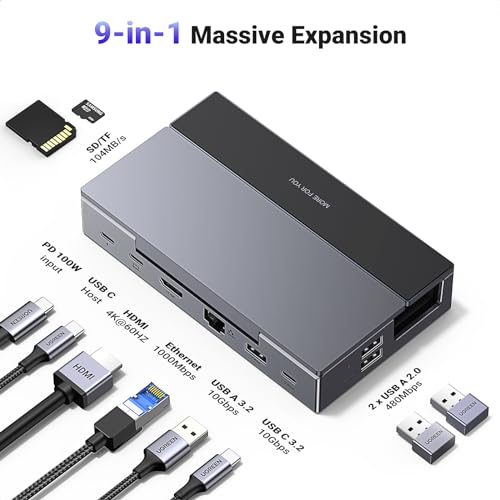
Steam Deck on the foldable stand, HDMI running to the TV at 1080p@120Hz, a controller plugged into USB, and Ethernet providing the wired connection that WiFi cannot match for online play. That is the UGREEN Steam Deck Dock in use. It turns a handheld gaming device into a living room console setup with one USB-C connection. The foldable stand holds the device upright and keeps the heat vents clear, which matters during long sessions when the Steam Deck runs hot. UGREEN built this specifically for handheld gaming consoles, and the specs reflect that: high refresh rate support up to 1080p@240Hz, 10 Gbps USB for fast game file transfers, 100W PD charging, Gigabit Ethernet, and SD/TF card readers for expanding storage. 420 grams, 24-month warranty, ranked #48 in Laptop Docking Stations.
It also works with ROG Ally, ROG X, Legion Go, MSI Claw A1M, and USB-C devices like iPad Pro/Air and Surface Pro 8. Not compatible with Switch 2.

UGREEN Steam Deck Dock 9-in-1 USB C Docking Station Foldable Stand | 4K@60Hz HDMI, Gigabit Ethernet, PD 100W, 10Gbps USB A&C 3.2, TF/SD For Steam Deck, Rog Ally, ROG Xbox Ally, Legion Go
Key Specifications
| Specification | Detail |
|---|---|
| Total Ports | 9 (Amazon lists 5 in one field, 9 in product name) |
| HDMI | 1 (4K@60Hz, 2K@144Hz, 1080p@240Hz, and more) |
| USB-A 3.2 Gen 2 | 1 (10 Gbps) |
| USB-C 3.2 Gen 2 | 1 (10 Gbps) |
| USB-A 2.0 | 2 (peripherals: keyboard, mouse, controller receiver) |
| Gigabit Ethernet | 1 |
| SD Card Reader | 1 |
| TF/MicroSD Reader | 1 |
| USB-C PD | 100W |
| Stand | Foldable dual-panel with heat dissipation clearance |
| Supported Resolutions | 4K@60Hz, 4K@30Hz, 2K@144Hz, 2K@120Hz, 2K@60Hz, 1080p@240Hz, 1080p@144Hz, 1080p@120Hz |
| Steam Deck Max Charge | 45W |
| ROG Ally Max Charge | 65W (supports 30W Turbo mode) |
| Compatible Devices | Steam Deck, ROG Ally, ROG X, ROG Xbox Ally, Legion Go, MSI Claw A1M, iPad Pro/Air, Surface Pro 8, Surface Go 3 |
| NOT Compatible | Switch 2 |
| Weight | 420g / 14.8 oz |
| Dimensions | 5.79″ L x 3.35″ W x 1.06″ H |
| Warranty | 24 months (UGREEN) |
The Foldable Stand: Built for Handhelds, Not Laptops
Most docking stations sit flat on a desk and connect to a laptop via cable. The UGREEN has a foldable stand that holds a handheld gaming console upright at an angle. The stand has two panels that fold out to cradle the device. The back panel is deliberately designed to leave the console’s heat vents unblocked. During a long gaming session when the Steam Deck’s fan is working hard, blocked vents cause thermal throttling and reduced performance. The UGREEN’s open-back design prevents that.

The angle also makes the console’s screen visible while it is docked, which matters if you are using the handheld as a controller while outputting video to a TV. You can glance at the handheld screen for information that is not on the TV display (inventory management, maps, system notifications) without picking the device up.
High Refresh Rate Support: The Gaming Detail
This is where the UGREEN separates from standard USB-C hubs. Most hubs support 4K@60Hz and stop there. The UGREEN supports: 4K@60Hz for cinematic visuals, 2K@144Hz for competitive gaming at high resolution, 2K@120Hz as an alternative, 1080p@240Hz for the highest possible refresh rate on competitive titles, 1080p@144Hz, and 1080p@120Hz.
The resolution and refresh rate you actually use depends on your TV or monitor and the game. Steam Deck outputs at up to 1080p natively. On a 1080p TV, 120Hz provides noticeably smoother gameplay than 60Hz in fast-paced titles. On a 1440p monitor, 2K@120Hz or 2K@144Hz gives both resolution and smooth motion. The dock supports the output. The console and the display determine what you actually see.
For competitive multiplayer games where frame rate matters more than resolution, 1080p@240Hz on a compatible monitor gives the smoothest possible input response. For single-player games where visuals matter more, 4K@60Hz provides the sharpest image. The dock handles both extremes and everything between them. For display connection details, see our USB-C portable monitor guide.
10 Gbps USB for Game Transfers
Moving games between an external SSD and the Steam Deck takes time at USB 3.0 speeds. The UGREEN’s two 10 Gbps USB 3.2 Gen 2 ports (one USB-A, one USB-C) cut that transfer time in half compared to 5 Gbps docks. A 50 GB game installs from an external drive in under a minute at 10 Gbps. The same transfer at 5 Gbps takes nearly two minutes. When you are setting up a new game library or moving titles between storage, the speed difference adds up.
The two USB-A 2.0 ports handle peripherals that do not need high bandwidth: wireless controller receivers, keyboard, mouse. These run at 480 Mbps which is more than enough for input devices. Keeping the low-bandwidth peripherals on USB 2.0 and the high-bandwidth storage on USB 3.2 prevents the ports from competing for the same bandwidth pool.

Device-Specific Charging
The 100W PD port delivers power tailored to each device’s limit. Steam Deck charges at a maximum of 45W. That is the Steam Deck’s ceiling, not the dock’s. The dock provides up to 100W, but the Steam Deck only draws what it needs. ROG Ally charges at up to 65W and supports 30W Turbo mode, which the dock enables. Legion Go and MSI Claw A1M draw their own rated wattage up to 100W.
The charger is not included. You supply your own USB-C PD charger. For Steam Deck, the original 45W charger works. For ROG Ally at full 65W, you need at least a 65W charger. For the dock to pass through 100W to other USB-C devices, a 100W charger is needed.
Gigabit Ethernet for Online Gaming
Steam Deck and ROG Ally connect to the internet via WiFi by default. WiFi introduces latency spikes, packet loss, and connection drops that competitive online games punish. The Gigabit Ethernet port on the UGREEN dock provides a wired connection that eliminates those issues. For online multiplayer, a wired connection means consistent ping, zero packet loss from wireless interference, and no disconnections from WiFi channel congestion.
For single-player games played offline, Ethernet is unnecessary. For downloading large games from Steam or other stores, Ethernet provides faster, more consistent download speeds than WiFi, especially on networks with many connected devices.
What’s in the Box
| Item | Included |
|---|---|
| UGREEN Steam Deck Dock (9-in-1) | 1 |
| Foldable Stand | Integrated |
| USB-C Cable | Built-in |
No power adapter included. No HDMI cable. No Ethernet cable. You supply the charger, monitor cable, and network cable.

Drawbacks
| Consideration | Detail |
|---|---|
| Not Compatible with Switch 2 | Explicitly excluded in the listing. |
| Single HDMI Only | One display output. No dual monitor. |
| 420 Grams | Heavier than laptop hubs due to the integrated stand. |
| No Charger Included | You supply your own USB-C PD charger. |
| Steam Deck Capped at 45W | The dock provides 100W but the Steam Deck draws only 45W max. |
Who This Dock Is For
Steam Deck, ROG Ally, and Legion Go owners who want to play on a TV or monitor with a wired controller and Ethernet: The foldable stand holds the handheld with vents clear. The HDMI supports up to 1080p@240Hz for competitive play and 4K@60Hz for cinematic visuals. 10 Gbps USB handles fast game transfers. Gigabit Ethernet provides wired stability for online multiplayer. 100W PD charges any compatible handheld at its maximum rate. 24-month UGREEN warranty. If you own a handheld gaming console and want a living room or desk setup that turns it into a console, this dock is purpose-built for that. For a UGREEN hub designed for laptops instead, see the UGREEN Revodok 1071 review.
Switch 2 owners or users who need dual display: Switch 2 is explicitly excluded. One HDMI means one screen. For those needs, see our docking stations hub page.
Final Verdict
The UGREEN Steam Deck Dock is a gaming dock, not a laptop dock. That focus is its strength. The foldable stand with heat dissipation clearance, the high refresh rate HDMI support up to 1080p@240Hz, the 10 Gbps USB for game transfers, the Gigabit Ethernet for online play, and the 100W PD for device-specific charging are all features chosen for handheld gaming, not spreadsheet productivity. UGREEN built this for the person who wants to sit on the couch, dock their Steam Deck or ROG Ally, and play on the big screen with a wired controller and a wired network. That experience, from this dock, works exactly the way it should.
Frequently Asked Questions
Can I use 1080p@240Hz on the Steam Deck?
The dock supports 1080p@240Hz output. Whether you achieve 240 frames per second depends on the game and the Steam Deck’s hardware. Most Steam Deck games run at 30-60 fps. The 240Hz support benefits handhelds with stronger GPUs like the ROG Ally in competitive titles that can push higher frame rates.
Why is Switch 2 not compatible?
The listing explicitly excludes Switch 2. Nintendo uses a proprietary docking protocol that third-party USB-C docks do not always support. The UGREEN does not claim Switch 2 compatibility.
Does the Steam Deck charge faster through this dock?
No. The Steam Deck’s maximum charging speed is 45W regardless of the dock’s 100W capability. The dock cannot push more power than the device accepts. The 100W PD benefits devices like the ROG Ally (65W) or USB-C laptops that draw more power.
Can I use this as a laptop dock?
The dock works with USB-C devices including iPad Pro/Air and Surface Pro 8. It can function as a basic laptop hub (one HDMI, USB ports, Ethernet, card readers, PD charging) but the foldable stand is designed for handheld gaming consoles, not laptops. For laptop-specific docks, the UGREEN Revodok 1071 or larger docking stations serve that purpose better.
Disclosure: As an Amazon Associate, I earn from qualifying purchases.

I evaluate docking stations the way they actually get used — against real bandwidth budgets, power-delivery ceilings, and the OS handshakes that quietly cap what a port can do — not spec-sheet promises. Every constraint that can break a multi-display setup is disclosed before any affiliate link.
Docking Station Intelligence
The standards are confusing by design. These three panels decode what manufacturers won’t explain clearly. Applicable to every docking station.
The USB-C Confusion Matrix
The USB-C connector is the single greatest source of buyer confusion in docking stations. The physical plug looks identical whether it carries USB 2.0 at 480 Mbps or Thunderbolt 5 at 120 Gbps — a 250x difference in capability hidden behind the same shape. Manufacturers exploit this by labeling everything "USB-C compatible" without specifying which protocol runs through it. Two docks can look identical on the outside and behave completely differently once you plug them in.
The hierarchy matters because it determines everything: how many monitors your dock can drive, how fast files transfer, whether your laptop charges while docked, and whether you need third-party drivers. Here is the real capability ladder, from slowest to fastest:
The practical takeaway: if your laptop has Thunderbolt 4, buy a Thunderbolt dock. If it only has generic USB-C, verify whether it supports DisplayPort Alt Mode before buying anything with multi-monitor claims. Our buying guide walks through verification steps for every major laptop brand.
Power Delivery: What the Watts Mean
Power Delivery (PD) determines whether your docking station can charge your laptop while you work, or whether you need a separate charger cluttering your desk. The math is simple but rarely explained: your laptop draws a specific wattage under load, and the dock must match or exceed it. If the dock delivers less than your laptop needs, the battery slowly drains even while plugged in — defeating the purpose of a docking station entirely.
Check the laptop manufacturer’s recommended power supply and the dock’s rated host power. Shared charging budgets vary by dock: powering peripherals does not reduce host charging on every model. USB-C charging also depends on the laptop, cable and negotiated power profile. A lower-power supply may charge slowly or allow battery drain under load; a fixed 15–20W margin is not a universal requirement.
Check your laptop’s original charger wattage — that’s your baseline. Our FAQ covers how to find this for every major brand.
Native Display vs DisplayLink: The Hidden Factor
This is the decision most buyers don’t know they’re making. When a docking station outputs video to your monitors, it uses one of two fundamentally different methods: native (the dock passes your laptop’s GPU signal directly to the monitor) or DisplayLink (the dock compresses video over USB and a software driver renders it). The difference is invisible in marketing materials but profoundly affects your daily experience.
Native output through DisplayPort Alt Mode or Thunderbolt uses the host graphics system. DisplayLink transports encoded display data over USB using compatible software. Its responsiveness and CPU/GPU load vary with the computer, software, resolution and workload; fixed latency, CPU and battery percentages are not universal specifications. Protected-video playback also depends on the display path, operating system and service. Check DisplayLink system requirements for your configuration.
DisplayLink can add displays through compatible USB connections, including USB-A, and can serve systems with limited native display outputs. Native limits depend on the exact computer and operating mode. For example, M3 MacBook Air and MacBook Pro support two external displays with the lid closed under Apple’s stated conditions. Choose the display method against your computer, software permissions and workload.
Native (Alt Mode / Thunderbolt)
DisplayLink (USB compression)
Choose a native or DisplayLink dock by checking the exact host, dock, operating system and monitor combination. Native output is often preferable for latency-sensitive workloads; DisplayLink can be useful for additional productivity displays and compatible USB-A hosts. Neither connector shape nor a generic bandwidth number proves compatibility.
COMMAND CENTERCOMMAND CENTER
Six tools that decode the confusion manufacturers create. Port protocols, power budgets, display configurations, compatibility, desk planning, and future-proofing. Full buying guide →
Port Protocol DecoderWhat does your connection type actually support? Glossary
Power Delivery CalculatorCan this dock keep your laptop charged?
Display Configuration PlannerCan your dock push enough pixels?
Laptop-to-Dock CompatibilityWill this dock work with YOUR laptop?
Desk Setup ArchitectWhat ports do you actually need?
Select everything you need to connect: