
Anker 7-in-1 USB-C Hub Review
Anker 7-in-1 USB-C Hub Review: Evaluate dual monitor display bandwidth, 10Gbps USB data speeds, 85W PD host charging, and Mac driver setup.
Two monitors from a hub that weighs 96 grams and fits in your palm. That is what the Anker 7-in-1 does. Plug it into your Dell XPS or ThinkPad’s USB-C port and two HDMI screens extend your workspace at 1080p@60Hz while the hub charges your laptop at 85W and transfers files at 10 Gbps. Your morning setup takes about three seconds: connect the hub, and your monitors, keyboard, mouse, and charging are all live. Anker’s name is on the box, which carries weight in the connectivity space. 18-month warranty. Ranked #41 in Laptop Docking Stations on Amazon.
The honest trade-off: both HDMI ports run at 1080p, not 4K. If you have been using a 4K external monitor through your laptop’s native HDMI, switching to the Anker hub drops your resolution. For document work, email, spreadsheets, and video calls, 1080p on two screens provides more usable workspace than 4K on one. For photo editing, design work, or any task where pixel density matters, 1080p on a 24-inch or larger monitor looks noticeably softer than 4K. The hub prioritizes dual-screen capability over single-screen resolution. No Ethernet, no card readers, no audio jack. Seven ports, dual monitors, fast data, laptop charging. That is the scope.
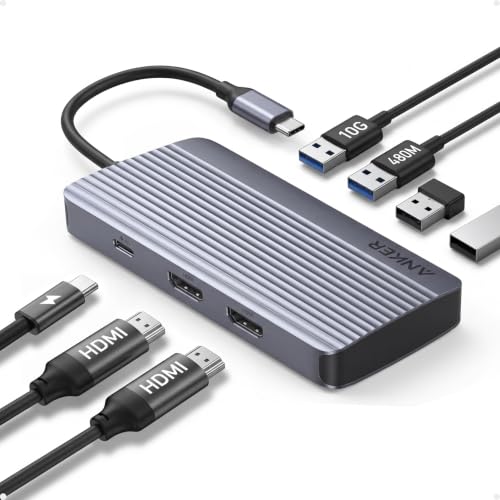
Anker 7-in-1 USB-C Hub, Dual Monitor USB C Docking Station | Dual HDMI Display, 85W Max Output, 10Gbps Data Transfers for Dell XPS, ThinkPad T14 Gen2 and More
Key Specifications
| Specification | Detail |
|---|---|
| Total Ports | 7 |
| HDMI | 2 (1080p@60Hz each) |
| USB Data Ports | 4 total (USB-C and USB-A) |
| Data Transfer | 10 Gbps |
| USB-C PD | 100W input, 85W output to laptop |
| Wall Charger | Not included |
| Enclosure | Plastic |
| Weight | 96g / 3.4 oz |
| Dimensions | 4.5″ L x 2.1″ W x 0.7″ H |
| Compatible OS | macOS 12+, Windows 10/11, ChromeOS |
| Connection Support | USB-C DP Alt Mode, USB4, Thunderbolt 3/4/5 |
| NOT Compatible | Linux |
| Amazon Ranking | #41 in Laptop Docking Stations |
| Warranty | 18 months (Anker) |

Dual 1080p Monitors: When Two Screens Beat One Sharper Screen
Two 1080p monitors at 60Hz give you two independent extended displays. Your email and calendar on one screen. Your main project on the other. Your laptop display handles chat, music, or whatever else. Three screens total from a hub that weighs less than a deck of cards.

The resolution is the buying decision. At 1080p, text is sharp enough on a 22 to 24-inch monitor. On a 27-inch monitor, 1080p starts to look soft because the same number of pixels stretches across more physical space. If your external monitors are 24 inches or smaller, 1080p looks good. If your monitors are 27 inches or larger, you will notice the lower pixel density compared to 1440p or 4K.
The reason the Anker runs dual HDMI at 1080p instead of 4K is bandwidth. Two 4K@60Hz streams require more bandwidth than most USB-C hubs can provide without Thunderbolt 4 or DisplayLink. The Anker uses native USB-C DP Alt Mode with MST (Multi-Stream Transport) to split one video stream into two, which caps each output at 1080p@60Hz. This is not a limitation of the Anker specifically. It is how MST works at this bandwidth tier. For USB-C display requirements, see our USB-C portable monitor guide.
10 Gbps: The Fastest Data Port in a 7-Port Hub
The 10 Gbps port transfers a 5 GB video file in approximately 4 seconds. For comparison, the Lenovo 7-in-1 hub runs at 480 Mbps (the same transfer takes over a minute) and the UGREEN Revodok 1071 runs at 5 Gbps (the same transfer takes about 8 seconds). The Anker’s 10 Gbps is double the UGREEN and twenty times faster than the Lenovo.
If you regularly move large files between an external SSD and your laptop, the 10 Gbps port makes the hub worth carrying for data transfer alone. Dragging a project folder from an external drive to your desktop finishes before you look away from the screen. That speed comes from one dedicated 10 Gbps port, not all ports running at 10 Gbps. The other USB ports handle peripherals at standard speeds.
85W Charging from 100W Input
You plug your own 100W charger into the hub’s PD port. The hub keeps 15W for its own operations and passes 85W to your laptop. MacBook Air charges at 30-45W. Most Windows ultrabooks charge at 45-65W. ThinkPad T14 Gen2 (named in the product title) charges at 65W. At 85W pass-through, the Anker charges all of these fully during use.
MacBook Pro 14-inch models that charge at 70-96W receive 85W, which is enough for standard productivity but may not maintain full charge during intensive tasks like video rendering or heavy compiles. The wall charger is not included. You supply your own USB-C PD charger.

96 Grams: The Dual-Monitor Hub That Disappears
The Anker weighs 96 grams. The UGREEN Revodok 1071 weighs 100 grams but has only one HDMI. The Lenovo 7-in-1 weighs 49 grams but runs at 480 Mbps with one HDMI. The Anker sits between them: heavier than the Lenovo, lighter than the UGREEN, but the only one with dual HDMI output and 10 Gbps data in the 7-port category.
The plastic enclosure is the weight trade-off. Aluminum (like the UGREEN) dissipates heat better and feels more durable. Plastic keeps weight down. At 96 grams with seven ports including dual HDMI, the plastic choice is deliberate: this is a travel hub first. For a desk dock that stays in one place, build material matters more. For a hub that lives in your bag and comes out when you need dual monitors, 96 grams of plastic does the job.
What This Hub Does Not Have
No Ethernet. No SD or microSD card reader. No 3.5mm audio jack. No VGA. Seven ports means seven ports. If you need wired network, card reading, or audio output through the hub, the Anker 563 (10 ports with Ethernet and card readers) or the Lemorele 13-in-1 (with VGA and Ethernet) cover those needs. The Anker 7-in-1 trades port count for the specific combination of dual HDMI + 10 Gbps data + 85W charging at minimal weight.
What’s in the Box
| Item | Included |
|---|---|
| Anker USB-C Hub (7-in-1, Dual Display) | 1 |
| Welcome Guide | 1 |
No wall charger. No HDMI cables. You supply the charger and monitor cables. For a dock that includes a power adapter, see our docking stations hub page.

Drawbacks
| Consideration | Detail |
|---|---|
| 1080p Only | Both HDMI ports max at 1080p@60Hz. No 4K output. |
| No Ethernet | WiFi only. |
| No Card Reader | No SD or microSD. |
| No Audio Jack | No 3.5mm output. |
| Plastic Build | Less heat dissipation and durability than aluminum. |
| Linux Not Supported | Excluded. |
| Wall Charger Not Included | You supply your own for PD. |
Who This Hub Is For
Dell XPS, ThinkPad, and MacBook users who want dual monitors from the lightest possible hub with fast data and Anker’s brand behind it: Two 1080p HDMI screens, 10 Gbps data, 85W charging, 96 grams, 18-month Anker warranty. If your desk or travel setup needs two monitors more than it needs 4K, Ethernet, or card readers, the Anker provides that at a weight no dual-HDMI competitor matches. For the Anker hub with more ports, see the Anker 563 USB-C Hub review.
Users who need 4K monitors, Ethernet, card readers, or Linux support: 1080p is the ceiling. No Ethernet, no readers, no audio, no Linux. For those needs, larger hubs from Anker’s own lineup (563, 778) or competitors serve better. See our docking stations hub page.
Final Verdict
The Anker 7-in-1 is the dual-monitor travel hub. Two HDMI screens at 1080p@60Hz, one 10 Gbps data port, 85W laptop charging, and Anker reliability at 96 grams. It does not try to be a desk dock. It does not chase port count. It provides the one thing most 7-port hubs cannot: two independent external monitors from a single USB-C connection at a weight that fits in a shirt pocket.
The 1080p resolution is the honest limit. On 24-inch monitors it looks sharp. On 27-inch monitors it looks soft. That is the trade-off for dual HDMI through USB-C without DisplayLink or Thunderbolt 4. For users whose productivity gains from two screens outweigh the resolution loss from 4K, the Anker provides that trade-off at the lightest weight, the fastest data speed, and the most recognized brand name in the 7-port dual-monitor category.
Frequently Asked Questions
Why is it 1080p and not 4K?
The hub uses MST (Multi-Stream Transport) to split one USB-C video stream into two HDMI outputs. At this bandwidth tier, each output caps at 1080p@60Hz. Dual 4K@60Hz requires Thunderbolt 4 or DisplayLink, which this hub does not use. The trade-off: two screens at lower resolution instead of one screen at higher resolution.
How does this compare to the UGREEN Revodok 1071?
The UGREEN has one HDMI (4K), SD/microSD readers, 5 Gbps USB, 95W charging, aluminum build, 100 grams. The Anker has dual HDMI (1080p), no card readers, 10 Gbps USB, 85W charging, plastic build, 96 grams. Choose the UGREEN for one sharp 4K screen with card readers. Choose the Anker for two 1080p screens with faster data transfer.
Will this work with my MacBook Air M2?
Yes, for dual 1080p extended displays. The hub supports USB-C with DP Alt Mode, which MacBook Air M2 has. macOS 12 or newer required. Both HDMI ports output independently at 1080p@60Hz.
Do I need to buy a charger?
Yes. The hub accepts up to 100W from your own USB-C PD charger and passes 85W to your laptop. No charger is included in the box.
Disclosure: As an Amazon Associate, I earn from qualifying purchases.

I evaluate docking stations the way they actually get used — against real bandwidth budgets, power-delivery ceilings, and the OS handshakes that quietly cap what a port can do — not spec-sheet promises. Every constraint that can break a multi-display setup is disclosed before any affiliate link.
Docking Station Intelligence
The standards are confusing by design. These three panels decode what manufacturers won’t explain clearly. Applicable to every docking station.
The USB-C Confusion Matrix
The USB-C connector is the single greatest source of buyer confusion in docking stations. The physical plug looks identical whether it carries USB 2.0 at 480 Mbps or Thunderbolt 5 at 120 Gbps — a 250x difference in capability hidden behind the same shape. Manufacturers exploit this by labeling everything "USB-C compatible" without specifying which protocol runs through it. Two docks can look identical on the outside and behave completely differently once you plug them in.
The hierarchy matters because it determines everything: how many monitors your dock can drive, how fast files transfer, whether your laptop charges while docked, and whether you need third-party drivers. Here is the real capability ladder, from slowest to fastest:
The practical takeaway: if your laptop has Thunderbolt 4, buy a Thunderbolt dock. If it only has generic USB-C, verify whether it supports DisplayPort Alt Mode before buying anything with multi-monitor claims. Our buying guide walks through verification steps for every major laptop brand.
Power Delivery: What the Watts Mean
Power Delivery (PD) determines whether your docking station can charge your laptop while you work, or whether you need a separate charger cluttering your desk. The math is simple but rarely explained: your laptop draws a specific wattage under load, and the dock must match or exceed it. If the dock delivers less than your laptop needs, the battery slowly drains even while plugged in — defeating the purpose of a docking station entirely.
Check the laptop manufacturer’s recommended power supply and the dock’s rated host power. Shared charging budgets vary by dock: powering peripherals does not reduce host charging on every model. USB-C charging also depends on the laptop, cable and negotiated power profile. A lower-power supply may charge slowly or allow battery drain under load; a fixed 15–20W margin is not a universal requirement.
Check your laptop’s original charger wattage — that’s your baseline. Our FAQ covers how to find this for every major brand.
Native Display vs DisplayLink: The Hidden Factor
This is the decision most buyers don’t know they’re making. When a docking station outputs video to your monitors, it uses one of two fundamentally different methods: native (the dock passes your laptop’s GPU signal directly to the monitor) or DisplayLink (the dock compresses video over USB and a software driver renders it). The difference is invisible in marketing materials but profoundly affects your daily experience.
Native output through DisplayPort Alt Mode or Thunderbolt uses the host graphics system. DisplayLink transports encoded display data over USB using compatible software. Its responsiveness and CPU/GPU load vary with the computer, software, resolution and workload; fixed latency, CPU and battery percentages are not universal specifications. Protected-video playback also depends on the display path, operating system and service. Check DisplayLink system requirements for your configuration.
DisplayLink can add displays through compatible USB connections, including USB-A, and can serve systems with limited native display outputs. Native limits depend on the exact computer and operating mode. For example, M3 MacBook Air and MacBook Pro support two external displays with the lid closed under Apple’s stated conditions. Choose the display method against your computer, software permissions and workload.
Native (Alt Mode / Thunderbolt)
DisplayLink (USB compression)
Choose a native or DisplayLink dock by checking the exact host, dock, operating system and monitor combination. Native output is often preferable for latency-sensitive workloads; DisplayLink can be useful for additional productivity displays and compatible USB-A hosts. Neither connector shape nor a generic bandwidth number proves compatibility.
COMMAND CENTERCOMMAND CENTER
Six tools that decode the confusion manufacturers create. Port protocols, power budgets, display configurations, compatibility, desk planning, and future-proofing. Full buying guide →
Port Protocol DecoderWhat does your connection type actually support? Glossary
Power Delivery CalculatorCan this dock keep your laptop charged?
Display Configuration PlannerCan your dock push enough pixels?
Laptop-to-Dock CompatibilityWill this dock work with YOUR laptop?
Desk Setup ArchitectWhat ports do you actually need?
Select everything you need to connect: