
Baseus Docking Station Spacemate Review
Baseus Spacemate 11-in-1 Docking Station Review: Evaluate triple-display resolution limits, 100W Power Delivery pass-through, 10Gbps USB-C data speeds, and Windows MST vs. Mac setup specs.
Vertical tower with a built-in LED screen that shows which ports are connected. That is not something you see on USB-C hubs. Most hubs are flat slabs with no status indication — you plug devices in and hope they registered. The Baseus Spacemate stands upright on a magnetic base, displays connection status for each port on a small LED panel, and includes a screen-lock button that blanks your monitors with one press. Four video outputs (dual HDMI, dual DisplayPort), three USB ports at 10 Gbps, Gigabit Ethernet, 85W pass-through charging, and a 3.5mm audio jack in an aluminum tower that takes 2.59″ x 2.59″ of desk surface. For a Windows user who wants a dock that looks and behaves differently from every flat hub on the market, the Spacemate stands out — literally.
Eleven ports. Triple display on Windows. Mac extends one monitor. USB 3.2 Gen 2 at 10 Gbps. 100W PD input / 85W to laptop. No charger included. 485g / 1.07 lbs. 80cm cable. 1-year warranty.

Baseus Spacemate Docking Station 11-in-1 with Triple Display for Windows | 2 x HDMI + 2 x DP 4K@60Hz, 10Gbps USB-A/C, Gigabit Ethernet, 100W PD, for Dell HP Lenovo Acer,No Adapter Included
Key Specifications
| Specification | Detail |
|---|---|
| Total Ports | 11 |
| HDMI | 2 (4K) |
| DisplayPort | 2 (4K) |
| USB-C (10 Gbps) | 1 |
| USB-A (10 Gbps) | 2 |
| USB-A 2.0 | 1 |
| USB-C PD | 100W input / 85W output to laptop |
| Gigabit Ethernet | 1 |
| 3.5mm Audio | 1 |
| Triple Display | Windows only. Mac extends one monitor. |
| Form Factor | Vertical tower with magnetic base |
| LED Status Screen | Yes (shows port connection status) |
| Screen-Lock Button | Yes (blanks monitors) |
| Cable Length | 80cm |
| Enclosure | Aluminum |
| Weight | 485g / 1.07 lbs |
| Dimensions | 2.59″ L x 2.59″ W x 4.84″ H |
| Charger Included | No. 100W adapter recommended. |
| Compatible OS | Windows 10/11, macOS 10.15+ |
| Manufacturer | Baseus |
| Warranty | 1 year |
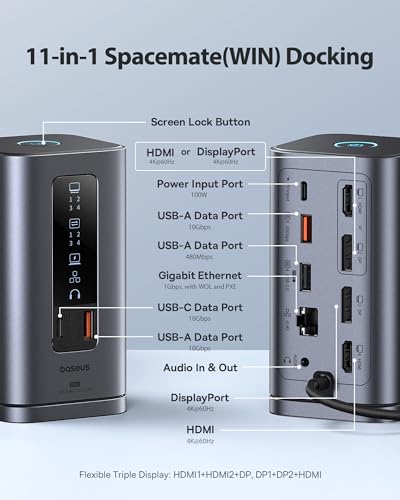
Vertical Tower: 2.59″ x 2.59″ Footprint
The Spacemate stands upright instead of lying flat. The base takes 2.59″ x 2.59″ of desk space — smaller than a coffee coaster. At 4.84″ tall, it rises vertically with ports accessible on the sides rather than the back. The magnetic base holds it stable without adhesive. For desks where horizontal space is limited, the vertical design trades height for footprint. An 80cm cable reaches from the dock to the laptop with enough slack for different desk arrangements.
LED Screen and Screen-Lock Button
The built-in LED screen shows which ports have active connections. When you plug in a monitor through HDMI 1, the screen reflects that. When Ethernet is connected, the screen shows it. For a dock with eleven ports running simultaneously, visual confirmation of connection status eliminates the “is it connected?” guesswork that happens with silent, indicator-free hubs.
The screen-lock button blanks all connected monitors with one press. Walk away from the desk, press the button, and the screens go dark without putting the laptop to sleep or locking the OS. The laptop continues running background tasks, downloads, and processes while the display output is secured. For open offices and shared spaces, that button is faster than Win+L and does not interrupt running applications.
Four Video Outputs: Triple Display on Windows
Two HDMI and two DisplayPort provide four video output ports. Triple display is supported on Windows through MST. Each port runs at 4K resolution. The fourth port provides a spare for different monitor configurations or connecting a projector alongside desk monitors. macOS extends to one external monitor only — no triple display on Mac through this dock.

Three 10 Gbps USB Ports
One USB-C and two USB-A at 10 Gbps (USB 3.2 Gen 2). One additional USB-A 2.0 for keyboard or mouse. Three Gen 2 ports handle external SSDs, fast peripherals, and modern USB-C accessories at full bandwidth. Baseus states 20GB file transfer in 20 seconds as the benchmark — that matches the theoretical throughput of 10 Gbps sustained.
85W to Laptop from 100W PD
The USB-C PD port accepts up to 100W from an external charger and delivers 85W to the laptop. The dock keeps 15W for its own operations. No charger is included — Baseus recommends a 65W adapter minimum and a 100W adapter when the dock is fully loaded. MacBook Air (30-45W) and most Windows ultrabooks (45-65W) charge at full speed. MacBook Pro 14″ (70-96W) charges at near full speed. Laptops drawing exactly 90-100W charge below their maximum rate.
Drawbacks
| Consideration | Detail |
|---|---|
| No Charger Included | 100W adapter sold separately. Required for full-load operation. |
| Mac: One Monitor Only | macOS extends to one external display. No triple on Mac. |
| 85W, Not 100W to Laptop | Dock reserves 15W. High-power laptops charge below full speed. |
| No Card Reader | No SD or MicroSD. |
| Vertical Only | Cannot lay flat. Tower design may not suit all desk setups. |
| 1-Year Warranty | Shorter than some competitors at 18-24 months. |

Who This Dock Is For
Windows users who want a vertical dock with an LED status screen, screen-lock button, four video outputs, 10 Gbps USB, Ethernet, and 85W charging in an aluminum tower that takes coaster-sized desk space: The Baseus Spacemate provides features that no flat hub offers — visual port status, one-button screen lock, and a form factor that stands instead of sprawls. Triple display on Windows. Four video ports. Three 10 Gbps USB. Gigabit Ethernet. 80cm cable. 1-year warranty. For a Baseus hub with fewer ports, see the Docking Stations.
Mac users who need triple display, buyers who need a card reader, or anyone who prefers a flat-lying dock: Mac gets one external monitor. No SD/MicroSD. The tower cannot lay flat. For those needs,
Final Verdict
The Baseus Spacemate does not look or behave like any other dock in this category. It stands vertically on a magnetic base, shows port status on an LED screen, and locks your monitors with a button. Those three features exist on enterprise docks that cost significantly more — the Spacemate brings them to the USB-C hub tier. Four video outputs, three 10 Gbps USB ports, Gigabit Ethernet, audio, and 85W pass-through in an aluminum tower that takes 2.59 inches of desk width. The missing charger, one-monitor Mac limitation, and 1-year warranty are the trade-offs. For the Windows user who wants a dock that does more than provide ports — one that shows status, secures screens, and saves desk space through vertical design — the Baseus Spacemate is the dock that nobody else is making.

Frequently Asked Questions
Does this include a charger?
No. The charger is sold separately. Baseus recommends 65W minimum and 100W when fully loaded.
What does the screen-lock button do?
It blanks all connected monitors without locking the OS or putting the laptop to sleep. Applications continue running. Press again to restore the display.
Can I lay this dock flat on the desk?
No. The Spacemate is designed to stand vertically on its magnetic base. It cannot lay flat like traditional hubs.
Does triple display work on Mac?
No. macOS extends to one external monitor only through this dock.
Disclosure: As an Amazon Associate, I earn from qualifying purchases.

I evaluate docking stations the way they actually get used — against real bandwidth budgets, power-delivery ceilings, and the OS handshakes that quietly cap what a port can do — not spec-sheet promises. Every constraint that can break a multi-display setup is disclosed before any affiliate link.
Docking Station Intelligence
The standards are confusing by design. These three panels decode what manufacturers won’t explain clearly. Applicable to every docking station.
The USB-C Confusion Matrix
The USB-C connector is the single greatest source of buyer confusion in docking stations. The physical plug looks identical whether it carries USB 2.0 at 480 Mbps or Thunderbolt 5 at 120 Gbps — a 250x difference in capability hidden behind the same shape. Manufacturers exploit this by labeling everything "USB-C compatible" without specifying which protocol runs through it. Two docks can look identical on the outside and behave completely differently once you plug them in.
The hierarchy matters because it determines everything: how many monitors your dock can drive, how fast files transfer, whether your laptop charges while docked, and whether you need third-party drivers. Here is the real capability ladder, from slowest to fastest:
The practical takeaway: if your laptop has Thunderbolt 4, buy a Thunderbolt dock. If it only has generic USB-C, verify whether it supports DisplayPort Alt Mode before buying anything with multi-monitor claims. Our buying guide walks through verification steps for every major laptop brand.
Power Delivery: What the Watts Mean
Power Delivery (PD) determines whether your docking station can charge your laptop while you work, or whether you need a separate charger cluttering your desk. The math is simple but rarely explained: your laptop draws a specific wattage under load, and the dock must match or exceed it. If the dock delivers less than your laptop needs, the battery slowly drains even while plugged in — defeating the purpose of a docking station entirely.
Check the laptop manufacturer’s recommended power supply and the dock’s rated host power. Shared charging budgets vary by dock: powering peripherals does not reduce host charging on every model. USB-C charging also depends on the laptop, cable and negotiated power profile. A lower-power supply may charge slowly or allow battery drain under load; a fixed 15–20W margin is not a universal requirement.
Check your laptop’s original charger wattage — that’s your baseline. Our FAQ covers how to find this for every major brand.
Native Display vs DisplayLink: The Hidden Factor
This is the decision most buyers don’t know they’re making. When a docking station outputs video to your monitors, it uses one of two fundamentally different methods: native (the dock passes your laptop’s GPU signal directly to the monitor) or DisplayLink (the dock compresses video over USB and a software driver renders it). The difference is invisible in marketing materials but profoundly affects your daily experience.
Native output through DisplayPort Alt Mode or Thunderbolt uses the host graphics system. DisplayLink transports encoded display data over USB using compatible software. Its responsiveness and CPU/GPU load vary with the computer, software, resolution and workload; fixed latency, CPU and battery percentages are not universal specifications. Protected-video playback also depends on the display path, operating system and service. Check DisplayLink system requirements for your configuration.
DisplayLink can add displays through compatible USB connections, including USB-A, and can serve systems with limited native display outputs. Native limits depend on the exact computer and operating mode. For example, M3 MacBook Air and MacBook Pro support two external displays with the lid closed under Apple’s stated conditions. Choose the display method against your computer, software permissions and workload.
Native (Alt Mode / Thunderbolt)
DisplayLink (USB compression)
Choose a native or DisplayLink dock by checking the exact host, dock, operating system and monitor combination. Native output is often preferable for latency-sensitive workloads; DisplayLink can be useful for additional productivity displays and compatible USB-A hosts. Neither connector shape nor a generic bandwidth number proves compatibility.
COMMAND CENTERCOMMAND CENTER
Six tools that decode the confusion manufacturers create. Port protocols, power budgets, display configurations, compatibility, desk planning, and future-proofing. Full buying guide →
Port Protocol DecoderWhat does your connection type actually support? Glossary
Power Delivery CalculatorCan this dock keep your laptop charged?
Display Configuration PlannerCan your dock push enough pixels?
Laptop-to-Dock CompatibilityWill this dock work with YOUR laptop?
Desk Setup ArchitectWhat ports do you actually need?
Select everything you need to connect: