
3 Monitors & Dual Display USB-C Docking Station Review:
Discover how the 14 in 1 Docking Station can declutter your workspace and simplify connectivity with 14 versatile ports. Dive into tech bliss with a touch of humor.
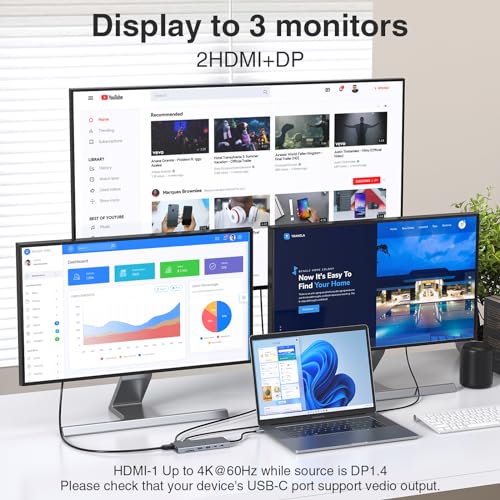
Three video outputs that each behave differently depending on how many you use at once. HDMI 1 runs at 4K@60Hz when used alone. DP and HDMI 2 each run at 4K@30Hz when used alone. Connect two displays and the combination caps at 4K@30Hz on one screen and 1080p@60Hz on the other. Connect all three and everything drops to 1080p. That cascade of resolution trade-offs is the reality of pushing triple display through a single USB-C connection without Thunderbolt bandwidth. The ABIWAZY 14-in-1 handles it, but understanding which screens get which resolution at which combination saves the setup frustration of expecting 4K on three monitors and getting 1080p on all of them.
Fourteen ports total: dual HDMI, DisplayPort, two USB-A 3.0 (5 Gbps), two USB-C data (5 Gbps), two USB 2.0, 87W PD, Gigabit Ethernet, SD/TF (104 MB/s, simultaneous), and a 3.5mm audio/mic combo. One limit worth knowing: only one external HDD or SSD can be connected at a time. macOS supports SST mode only (mirror or ABB). 1-year manufacturer warranty.

USB C Docking Station 3 Monitors USBC Hub Laptop Dual Monitor Multi Adapter
Key Specifications
| Specification | Detail |
|---|---|
| Total Ports | 14 |
| HDMI 1 | 4K@60Hz (single use, DP 1.4 source) |
| HDMI 2 | 4K@30Hz (single use, DP 1.4 source) |
| DisplayPort | 4K@30Hz (single use, DP 1.4 source) |
| Dual Display | 4K@30Hz + 1080p@60Hz (DP 1.4 source) |
| Triple Display | 1080p on all three |
| USB-A 3.0 | 2 (5 Gbps) |
| USB-C Data | 2 (5 Gbps) |
| USB 2.0 | 2 |
| USB-C PD | 87W |
| Gigabit Ethernet RJ-45 | 1 (10/100/1000 Mbps) |
| SD Card Reader | 1 (104 MB/s, simultaneous with TF) |
| TF/MicroSD Reader | 1 (104 MB/s, simultaneous with SD) |
| 3.5mm Audio/Mic | 1 (combo jack) |
| HDD/SSD Limit | Only 1 external drive at a time |
| macOS Display | SST only (AAA mirror or ABB) |
| DP Alt Mode Required | Yes |
| Manufacturer | ABIWAZY |
| Warranty | 1 year manufacturer |

Display Resolution Cascade
Four display scenarios, each with a trade-off:

Single HDMI 1: 4K@60Hz. The sharpest, smoothest output available from this dock. If you use one monitor, plug it into HDMI 1.
Single DP or HDMI 2: 4K@30Hz. Still sharp but motion stutters compared to 60Hz.
Two displays: 4K@30Hz on one screen and 1080p@60Hz on the other. Your primary monitor gets 4K. Your secondary gets 1080p. The bandwidth runs out before both can sustain 4K.
Three displays: 1080p on all three. No 4K anywhere. The USB-C connection cannot feed three 4K signals simultaneously. If you need triple monitors for email, Slack, and a browser — three 1080p screens handle that. If you need sharp 4K across multiple monitors, a Thunderbolt dock or a DisplayLink dock provides more bandwidth.
All of this requires a DP 1.4 source from your laptop. With DP 1.2, the resolutions will be lower. For USB-C display requirements, see the USB-C portable monitor guide.
One HDD or SSD at a Time
Only one external HDD or SSD at a time. Despite having four USB-A/USB-C data ports, the dock limits external storage to a single drive. Connecting a second drive may result in disconnections, data errors, or the drive simply not mounting. For a keyboard and mouse alongside one external drive, the port count is sufficient. For users who work with multiple drives simultaneously (backing up one to another, editing from one while saving to another), this dock does not support that workflow.
87W PD and the Missing 13W
The PD port passes 87W to the laptop. ABIWAZY describes this as a “safety” rated power level, meaning the dock limits power below the full 100W USB-C PD specification to reduce heat and risk. The practical effect: MacBook Air (30-45W) and Windows ultrabooks (45-65W) charge at full speed. MacBook Pro 14″ (70-96W) charges at near full speed. Laptops that draw exactly 90-100W charge below their maximum rate. No charger is mentioned as included.
macOS: SST Mode Only
macOS users get mirror (AAA — all screens show the same content) or ABB (laptop shows one thing, both external monitors show the same second thing). No independent dual extend with different content on each external screen. For Mac users who need two independent external displays, a DisplayLink dock or a Thunderbolt dock with M-series Pro/Max chip provides that.
Seven USB Ports: Mix of Speeds
Two USB-A 3.0 at 5 Gbps for drives and fast peripherals. Two USB-C at 5 Gbps for modern accessories. Two USB 2.0 for keyboard, mouse, and wireless receivers. The USB 2.0 separation is practical — keyboards and mice do not need 5 Gbps, and USB 2.0 ports produce less electromagnetic interference that can affect wireless peripherals nearby. Seven USB ports is a high count for this category, limited by the one-drive restriction.
Extensive Compatibility List
Compatible models include: HP EliteBook 630/640/645/650/655 G9, EliteBook 840/850 G6-G9, EliteBook x360 830/1030/1040, ProBook 440/450/455/650, ZBook Fury 15/17 G8, OMEN 16/17. Dell XPS 13/15/17, Latitude 5540/5440/7340/7440/3520, Precision 7730/7750. Lenovo ThinkPad X1 Carbon, T14/T480/T490s, Yoga 720/730/900/920/C930/C940. Surface Pro 7/8/9, Surface Book 2, Surface Laptop 3/4. Huawei MateBook X/X Pro. Google Chromebook Pixel. If your laptop model appears on this list, ABIWAZY has noted compatibility.

Drawbacks
| Consideration | Detail |
|---|---|
| Triple Display: 1080p Only | No 4K when three monitors are connected. |
| One HDD/SSD at a Time | Cannot connect multiple external drives simultaneously. |
| macOS: Mirror or ABB Only | No independent dual extend on Mac. |
| 87W, Not 100W | High-power laptops charge below full speed. |
| USB 3.0, Not Gen 2 | 5 Gbps, not 10 Gbps. |
| SD/TF at UHS-I | 104 MB/s. UHS-II cards bottlenecked. |
| Lesser-Known Brand | ABIWAZY has less market presence than Anker, UGREEN, or Lenovo. |
| HDMI Ports Not Equal | HDMI 1 does 4K@60Hz. HDMI 2 caps at 4K@30Hz. |
Who This Dock Is For
Windows laptop owners who need triple display capability with a DisplayPort option, seven USB ports, and a detailed compatibility list at a budget price: The ABIWAZY provides three video outputs (dual HDMI + DP), seven USB ports, Ethernet, audio, and card readers in fourteen ports. Triple display works at 1080p. Dual display reaches 4K@30Hz + 1080p. Single HDMI 1 reaches 4K@60Hz. The named compatibility list covers dozens of specific HP, Dell, Lenovo, Surface, and Huawei models. 1-year warranty. For a 14-port hub with VGA instead of DisplayPort, see the 14-in-1 USB-C Hub review.
Users who need dual 4K@60Hz, multiple drives, or Mac extended display: Dual display caps at 4K@30Hz + 1080p. Only one external drive at a time. Mac gets mirror or ABB only. For those needs, see the docking stations hub page.
Final Verdict
The ABIWAZY 14-in-1 gives you fourteen ports including three video outputs with DisplayPort, seven USB ports, Ethernet, card readers, audio, and 87W PD. The display cascade — 4K@60Hz single, 4K@30Hz + 1080p dual, 1080p triple — is the honest reality of triple display through USB-C without Thunderbolt. The one-drive limitation and macOS mirror-only behavior are restrictions that the buyer should know before ordering. For the Windows user who needs triple 1080p monitors for multitasking and does not need 4K on all three screens, the ABIWAZY provides that with the largest USB port count in the 14-port category. Plug your primary monitor into HDMI 1 for the sharpest single output, and plan the rest of your display setup around the resolution trade-offs.
Frequently Asked Questions
Can I get 4K on three monitors?
No. Triple display runs at 1080p on all three screens. The USB-C connection does not have enough bandwidth for triple 4K. Dual display reaches 4K@30Hz on one screen and 1080p on the other.
Which HDMI port should I use for my main monitor?
HDMI 1. It supports 4K@60Hz when used alone. HDMI 2 caps at 4K@30Hz.
Can I connect two external hard drives?
No. Only one HDD/SSD can be connected at a time, despite having multiple USB ports.
Does it work with Mac for dual extended displays?
No. macOS supports SST mode only: mirror (AAA) or ABB where both external monitors show the same content. For Mac dual extended display, use a DisplayLink dock or a Thunderbolt dock with M-series Pro/Max chip.
Disclosure: As an Amazon Associate, I earn from qualifying purchases.

I evaluate docking stations the way they actually get used — against real bandwidth budgets, power-delivery ceilings, and the OS handshakes that quietly cap what a port can do — not spec-sheet promises. Every constraint that can break a multi-display setup is disclosed before any affiliate link.
Docking Station Intelligence
The standards are confusing by design. These three panels decode what manufacturers won’t explain clearly. Applicable to every docking station.
The USB-C Confusion Matrix
The USB-C connector is the single greatest source of buyer confusion in docking stations. The physical plug looks identical whether it carries USB 2.0 at 480 Mbps or Thunderbolt 5 at 120 Gbps — a 250x difference in capability hidden behind the same shape. Manufacturers exploit this by labeling everything "USB-C compatible" without specifying which protocol runs through it. Two docks can look identical on the outside and behave completely differently once you plug them in.
The hierarchy matters because it determines everything: how many monitors your dock can drive, how fast files transfer, whether your laptop charges while docked, and whether you need third-party drivers. Here is the real capability ladder, from slowest to fastest:
The practical takeaway: if your laptop has Thunderbolt 4, buy a Thunderbolt dock. If it only has generic USB-C, verify whether it supports DisplayPort Alt Mode before buying anything with multi-monitor claims. Our buying guide walks through verification steps for every major laptop brand.
Power Delivery: What the Watts Mean
Power Delivery (PD) determines whether your docking station can charge your laptop while you work, or whether you need a separate charger cluttering your desk. The math is simple but rarely explained: your laptop draws a specific wattage under load, and the dock must match or exceed it. If the dock delivers less than your laptop needs, the battery slowly drains even while plugged in — defeating the purpose of a docking station entirely.
Most ultrabooks need 45–65W. Standard business laptops need 65–100W. Gaming and workstation laptops can demand 100–140W or more. The dock’s advertised PD wattage is the maximum it can deliver to your laptop — but this drops if you charge other devices (phones, tablets) through the dock simultaneously. Always leave a 15–20W margin above your laptop’s requirement.
Check your laptop’s original charger wattage — that’s your baseline. Our FAQ covers how to find this for every major brand.
Native Display vs DisplayLink: The Hidden Factor
This is the decision most buyers don’t know they’re making. When a docking station outputs video to your monitors, it uses one of two fundamentally different methods: native (the dock passes your laptop’s GPU signal directly to the monitor) or DisplayLink (the dock compresses video over USB and a software driver renders it). The difference is invisible in marketing materials but profoundly affects your daily experience.
Native output through DisplayPort Alt Mode or Thunderbolt uses your laptop’s actual graphics hardware. There is zero added latency, full DRM support for streaming services, no CPU overhead, and no driver to install. DisplayLink, by contrast, adds 5–15ms of latency (noticeable in video calls and cursor movement), blocks DRM content on connected monitors (Netflix, Disney+ show black screens), consumes 3–8% of your CPU constantly, and requires a driver that Apple’s macOS security updates occasionally break.
DisplayLink exists for one reason: Apple Silicon base chips (M1, M2, M3) can only drive one external display natively. If you need two or more monitors on a base MacBook Air or 13” MacBook Pro, DisplayLink is your only option. For everyone else — Windows users, Mac Pro/Max chip users, Intel/AMD laptops — native is always the better choice.
Native (Alt Mode / Thunderbolt)
DisplayLink (USB compression)
The bottom line: if your laptop supports native multi-display output, always choose a native dock. DisplayLink is a workaround, not an upgrade. See our glossary for detailed definitions.
COMMAND CENTERCOMMAND CENTER
Six tools that decode the confusion manufacturers create. Port protocols, power budgets, display configurations, compatibility, desk planning, and future-proofing. Full buying guide →
Port Protocol DecoderWhat does your connection type actually support? Glossary
Power Delivery CalculatorCan this dock keep your laptop charged?
Display Configuration PlannerCan your dock push enough pixels?
Laptop-to-Dock CompatibilityWill this dock work with YOUR laptop?
Desk Setup ArchitectWhat ports do you actually need?
Select everything you need to connect: