
LIONWEI 13-in-1 USB-C Docking Station Review
The LIONWEI 13-in-1 packs two HDMI, a DisplayPort, eight USB ports, Gigabit Ethernet and 87W charging into a 4.9-ounce USB-C dock. This review covers the video ports, the Mac limit, the charging maths, and the gaps in the listing
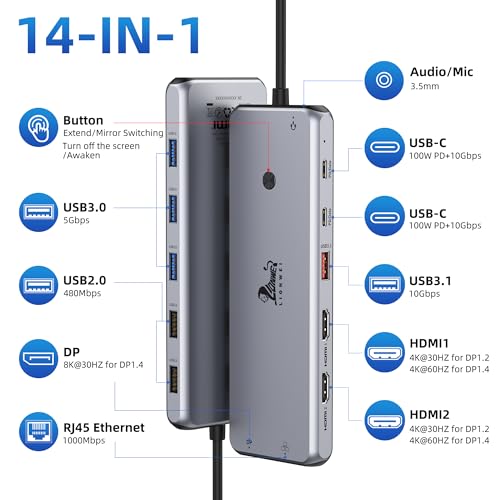
Thirteen ports, three of them video, in a 4.9-ounce hub. The LIONWEI 13-in-1 gives a laptop two HDMI outputs and a DisplayPort, two USB-C ports that LIONWEI rates for 100W Power Delivery and 10 Gbps data, one USB-A at 10 Gbps, three USB 3.0 and two USB 2.0 ports, Gigabit Ethernet and a headset jack, with nothing to install on Windows or macOS. It is the successor to the 11-in-1 this page used to cover, which Amazon now lists as unavailable, and it fixes that dock’s two worst habits: the VGA port that dragged everything to 1080p is gone, replaced by a DisplayPort, and both HDMI ports are now rated for 4K@60Hz rather than one of them being stuck at 30Hz. At 4.3 stars from more than 13,000 buyers with an Amazon’s Choice badge, it is one of the most-bought docks on Amazon.
Read the display bullet before buying it for three screens. LIONWEI rates each video port at up to 4K@60Hz with a DisplayPort 1.4 laptop, but says nothing about what two or three screens get at the same time, and the whole dock shares one USB-C link. On macOS, extend mode works on one monitor only. The charger is yours to supply, and the dock keeps 13W of it.

Docking Station Dual Monitor 4K HDMI 13-in-1 USB C Hub for Laptop MacBook
Key Specifications
| Specification | Detail |
|---|---|
| Total Ports | 13 |
| HDMI | 2, each up to 4K@60Hz with a DP 1.4 source |
| DisplayPort | 1, up to 4K@60Hz |
| Simultaneous Display Figures | Not stated for two or three screens together |
| USB-C | 2, both rated 100W PD and 10 Gbps |
| USB-A 3.1 | 1 (10 Gbps) |
| USB-A 3.0 | 3 (5 Gbps) |
| USB 2.0 | 2 |
| Gigabit Ethernet RJ-45 | 1 |
| Audio | 3.5mm headphone and mic combo jack |
| Power Delivery | 100W in, 87W to the laptop (dock uses 13W) |
| Charger | Not included; a USB-C PD adapter of your own |
| Display: Windows | MST and SST, extend or mirror |
| Display: macOS | Extend on one monitor only, at up to 4K@60Hz |
| Switching Mode Button | Listed in the title; function not explained |
| Driver Required | No |
| Minimum OS | Windows 10, macOS 10.7 |
| Enclosure | Not stated |
| Weight | 4.9 oz |
| Dimensions | Not stated |
| Manufacturer | LIONWEI |
| Warranty | 18 months |
Three Video Ports, One Link
The three outputs are two HDMI and one DisplayPort, and LIONWEI rates each of them at up to 4K@60Hz when the laptop’s USB-C port carries DisplayPort 1.4. That is an improvement on the old 11-in-1, where only the second HDMI port reached 60Hz and the VGA port pulled every screen down to 1080p. What the listing does not give is the figure for two or three screens at once. A USB-C dock without Thunderbolt pushes all its video through one DisplayPort link from the laptop, so three 4K@60Hz screens is not on the table; two screens at a lower refresh rate or resolution is the usual outcome, and the exact numbers depend on the laptop’s port. Windows gets a choice of extend or mirror through MST and SST. If you need three high-resolution screens, a DisplayLink dock is the right tool, not this one.

The title also promises a switching mode button, which the bullets never mention again. On docks of this kind such a button usually toggles between the Windows multi-monitor mode and a Mac-friendly mode; LIONWEI does not say, so ask before relying on it. For how USB-C video output works and why the laptop’s port sets the ceiling, see our USB-C portable monitor guide.
macOS: One Extended Monitor
LIONWEI is direct about it: on macOS, extend mode works on one monitor, at up to 4K@60Hz. That is a step up from the old 11-in-1, which could only mirror on a Mac, and it is the normal limit of a native USB-C hub on Apple’s chips. A MacBook owner who wants one good external screen plus the ports gets exactly that. A MacBook owner who wants two independent screens needs a DisplayLink dock instead; see our docking stations hub page for those.
Eight USB Ports, Two of Them at 10 Gbps
LIONWEI describes both USB-C ports as supporting 100W Power Delivery and 10 Gbps data, which reads as though either can take the charger while the other carries a fast drive or a phone. One USB-A port also runs at 10 Gbps, three run at 5 Gbps for the printer, the webcam and ordinary drives, and two USB 2.0 ports take the keyboard and mouse receivers, where the lower electrical noise of USB 2.0 keeps 2.4 GHz wireless dongles happy. Gigabit Ethernet gives a wired connection for calls and downloads, and the 3.5mm jack is a headphone-and-mic combo for a headset.

87W to the Laptop From a 100W Charger
The dock takes up to 100W from a USB-C PD adapter and passes 87W to the laptop, keeping 13W for itself, and LIONWEI says so plainly rather than advertising the 100W. That charges a MacBook Air, a 14-inch MacBook Pro or any Windows ultrabook at full speed and a larger laptop a little below it. The adapter is not in the box; the laptop’s own USB-C charger usually does the job, and a 65W one will simply pass 52W. The laptop’s USB-C port must support Power Delivery for any of this to work.
Build
The listing gives a weight of 4.9 ounces and nothing else: no dimensions and no enclosure material. The old 11-in-1 was plastic, and LIONWEI’s mention of heat resistance in Amazon’s feature field hints that this one is too, but it is not stated. Model and part numbers on the listing both read “1”, which is a placeholder rather than a model, and the colour picker offers nine variants at four prices, several of them labelled 13-in-1 with different port mixes; the one reviewed here is the “13-in-1 Docking Station (USB C)” option.

Drawbacks
| Consideration | Detail |
|---|---|
| No Multi-Screen Figures | 4K@60Hz is quoted per port; nothing is said about two or three screens together. |
| macOS: One Extended Screen | Two independent Mac displays need a DisplayLink dock. |
| Charger Not Included | Bring a USB-C PD adapter; the laptop gets 87W of it at most. |
| Switching Button Unexplained | In the title, absent from the bullets. |
| Enclosure and Size Not Stated | Only the 4.9 oz weight is given. |
| Nine Variants on One Listing | Several share the 13-in-1 name with different ports; confirm the option before buying. |
| Placeholder Model Number | Model and part fields read “1”. |
Who This Dock Is For
Windows laptop owners who want the whole desk on one cable for the price of a cable: two or three screens on HDMI and DisplayPort, eight USB ports with two at 10 Gbps, wired network, a headset jack and 87W of charging, driver-free. If you own a 100W USB-C charger already, the total cost is the dock. For LIONWEI’s other dock on this site, see the LIONWEI Laptop Docking Station review.
MacBook owners who need one external monitor and every port: extend on one 4K@60Hz screen, charge at 87W, and get Ethernet, USB-A and a headset jack back on a laptop that has none of them.
Anyone who needs three sharp screens or two independent Mac displays: this dock cannot promise the first and does not offer the second. DisplayLink docks do both; our docking stations hub page lists them, and the Newmight Dual HDMI Adapter review covers a simpler two-screen adapter.
Final Verdict
The LIONWEI 13-in-1 is the budget dock that most people actually buy, and the listing is honest enough to make that a reasonable choice: every port is named, the 87W charging figure is stated instead of hidden behind the 100W, and the Mac limit is written down. It removes the two things that made the old 11-in-1 hard to recommend, the VGA port and the mismatched HDMI outputs, and adds a DisplayPort and a second 10 Gbps port at the same size.
What it does not tell you is how two or three screens share the link, what the switching button does, or what the box is made of, and it leaves the charger to you. For a Windows laptop with a full-featured USB-C port and one or two monitors, those are small gaps at this price. For three high-resolution screens or a two-screen Mac desk, buy a DisplayLink dock and skip this one.
Frequently Asked Questions
Can I run three 4K@60Hz monitors?
LIONWEI rates each port at up to 4K@60Hz but gives no figure for all three at once, and a USB-C dock shares one video link from the laptop, so do not expect three 4K@60Hz screens. Two screens at a reduced refresh rate or resolution is the realistic case; the exact numbers depend on your laptop’s port.
Does it extend two monitors on a MacBook?
No. LIONWEI states that macOS extends one monitor, at up to 4K@60Hz. Two independent Mac displays need a DisplayLink dock.
Does it charge my laptop?
Yes, up to 87W, from a USB-C PD adapter you plug into the dock; LIONWEI includes none. The dock keeps 13W of a 100W supply for itself.
What does the switching mode button do?
The title mentions it and the listing never explains it. Ask LIONWEI before buying if you are counting on it.
Is this a Thunderbolt dock?
No. It is a USB-C dock using DisplayPort Alt Mode and Power Delivery, and it works from a Thunderbolt port because Thunderbolt ports support both.
Disclosure: As an Amazon Associate, I earn from qualifying purchases.

I evaluate docking stations the way they actually get used — against real bandwidth budgets, power-delivery ceilings, and the OS handshakes that quietly cap what a port can do — not spec-sheet promises. Every constraint that can break a multi-display setup is disclosed before any affiliate link.
Docking Station Intelligence
The standards are confusing by design. These three panels decode what manufacturers won’t explain clearly. Applicable to every docking station.
The USB-C Confusion Matrix
The USB-C connector is the single greatest source of buyer confusion in docking stations. The physical plug looks identical whether it carries USB 2.0 at 480 Mbps or Thunderbolt 5 at 120 Gbps — a 250x difference in capability hidden behind the same shape. Manufacturers exploit this by labeling everything "USB-C compatible" without specifying which protocol runs through it. Two docks can look identical on the outside and behave completely differently once you plug them in.
The hierarchy matters because it determines everything: how many monitors your dock can drive, how fast files transfer, whether your laptop charges while docked, and whether you need third-party drivers. Here is the real capability ladder, from slowest to fastest:
The practical takeaway: if your laptop has Thunderbolt 4, buy a Thunderbolt dock. If it only has generic USB-C, verify whether it supports DisplayPort Alt Mode before buying anything with multi-monitor claims. Our buying guide walks through verification steps for every major laptop brand.
Power Delivery: What the Watts Mean
Power Delivery (PD) determines whether your docking station can charge your laptop while you work, or whether you need a separate charger cluttering your desk. The math is simple but rarely explained: your laptop draws a specific wattage under load, and the dock must match or exceed it. If the dock delivers less than your laptop needs, the battery slowly drains even while plugged in — defeating the purpose of a docking station entirely.
Most ultrabooks need 45–65W. Standard business laptops need 65–100W. Gaming and workstation laptops can demand 100–140W or more. The dock’s advertised PD wattage is the maximum it can deliver to your laptop — but this drops if you charge other devices (phones, tablets) through the dock simultaneously. Always leave a 15–20W margin above your laptop’s requirement.
Check your laptop’s original charger wattage — that’s your baseline. Our FAQ covers how to find this for every major brand.
Native Display vs DisplayLink: The Hidden Factor
This is the decision most buyers don’t know they’re making. When a docking station outputs video to your monitors, it uses one of two fundamentally different methods: native (the dock passes your laptop’s GPU signal directly to the monitor) or DisplayLink (the dock compresses video over USB and a software driver renders it). The difference is invisible in marketing materials but profoundly affects your daily experience.
Native output through DisplayPort Alt Mode or Thunderbolt uses your laptop’s actual graphics hardware. There is zero added latency, full DRM support for streaming services, no CPU overhead, and no driver to install. DisplayLink, by contrast, adds 5–15ms of latency (noticeable in video calls and cursor movement), blocks DRM content on connected monitors (Netflix, Disney+ show black screens), consumes 3–8% of your CPU constantly, and requires a driver that Apple’s macOS security updates occasionally break.
DisplayLink exists for one reason: Apple Silicon base chips (M1, M2, M3) can only drive one external display natively. If you need two or more monitors on a base MacBook Air or 13” MacBook Pro, DisplayLink is your only option. For everyone else — Windows users, Mac Pro/Max chip users, Intel/AMD laptops — native is always the better choice.
Native (Alt Mode / Thunderbolt)
DisplayLink (USB compression)
The bottom line: if your laptop supports native multi-display output, always choose a native dock. DisplayLink is a workaround, not an upgrade. See our glossary for detailed definitions.
COMMAND CENTERCOMMAND CENTER
Six tools that decode the confusion manufacturers create. Port protocols, power budgets, display configurations, compatibility, desk planning, and future-proofing. Full buying guide →
Port Protocol DecoderWhat does your connection type actually support? Glossary
Power Delivery CalculatorCan this dock keep your laptop charged?
Display Configuration PlannerCan your dock push enough pixels?
Laptop-to-Dock CompatibilityWill this dock work with YOUR laptop?
Desk Setup ArchitectWhat ports do you actually need?
Select everything you need to connect: