
Docking Station USB C to Dual HDMI Adapter Review
Explore an amusing take on the MOKiN USB C Dock in our review! Discover how it transforms tech clutter into harmony with seamless connections and 4K brilliance.
Is there anything more irritating than a cluttered desk and a just-out-of-reach USB port? I find myself wrestling daily with an ever-growing bundle of cords and cables, which seems more suited for a creature from another world rather than an easily manageable workspace.

MOKiN USB C Docking Station Dual Monitor 2 HDMI for Dell/Lenovo/HP Laptop | USB C Hub 2 Monitors Dual HDMI 4K@60HZ, 2 HDMI, USB A 3.1/2*USB A 2.0/USB C Charging Port
The Quest for the Perfect Solution
I recently stumbled upon a gadget that promises to be the unsung hero in my daily quest for digital order: the Docking Station USB C to Dual HDMI Adapter, also known as the MOKiN USB C Hub Dual HDMI Monitors.

This handy device presents an answer to many of my tech troubles, converting the solitary USB C port on my laptop into six versatile outlets. No more juggling wires like a circus performer or sulking as I surrender my dignity, crawling under my desk to retrieve that fallen plug.
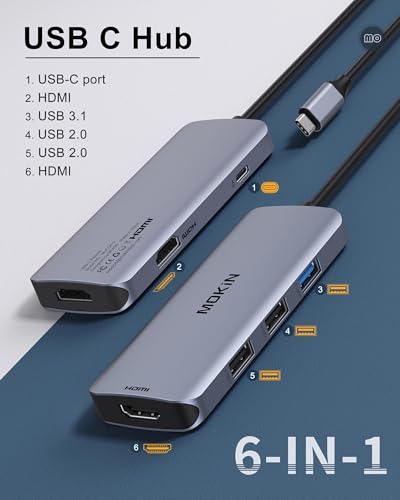
Conversion Power and Ports Galore
The device boasts some impressive conversion power. Plug it into your USB C port, and suddenly your laptop becomes a technological equivalent of a Swiss army knife. The conversion transforms one simple port into two HDMI outputs, one USB 3.1, and two USB 2.0 connections, not to mention a 100w power delivery.
To illustrate the versatility of the MOKiN hub, here’s a brief breakdown of its six ports:
| Port Type | Function |
|---|---|
| 2x HDMI (4K 30Hz) | Mirror or extend displays, support vivid 4K/30Hz video |
| 1x USB 3.1 | High-speed data transfer at 10Gbps |
| 2x USB 2.0 | Connect mouse, keyboard, etc., without lag |
| Power Delivery | 100w PD for power support |
I must admit, seeing my workspace lean towards orderliness with the help of this adapter is quite thrilling. It’s as if the tech gods finally heard my silent plea as I oft muttered under my breath, threatening the cables with banishment.
Effortless Installation: Just Plug and Play
No need to decipher complex driver installations or dent your spirit with the installation of some cumbersome application. The MOKiN dock is as simple as plug and play, an instinctive design akin to slipping a letter into a postbox. It’s the tech equivalent of making toast; pop it in, and there it is, without any fuss.
This docking station is compatible with a variety of Windows laptops, boasting support for both Single Stream Transport (SST) and Multi-Stream Transport (MST) modes—ideal for triple displays on your Windows device. Note, dear Apple users: while it supports MacBooks, the capability here is limited to mirror mode without the tantalizing prospect of a triple display.

Crystal Clear 4K Video Transmission
Visual clarity is vital; no one likes deciphering a blurry PowerPoint presentation or squinting at choppy video graphics. The MOKiN USB C dock does wonders here. With its HDMI ports, you can extend or mirror your laptop’s display in 4K Ultra HD at 30Hz, or settle for Full HD 1080p. This feature caters beautifully to streaming movies, presenting your latest work project, or indulging in the colorful chaos of a video game.
Forget about that tangle of old VGA and DVI cables that snarl at you in complacency—there’s a new sheriff in town, and pixel precision is its decree.
Pace with Fast Data Transfer
What’s the point of transferring files if time seems to stretch infinitely as you watch the progress bar inch forward like a reluctant snail? Thanks to the MOKiN dock, those days are over. Its USB 3.1 port provides a staggering 10Gbps transfer speed, enough to send your data aspirations into the stratosphere.
Craving a more leisurely pace? The two USB 2.0 ports have your back, perfect for connecting a trusty keyboard or mouse without any lag. Safe to say, maneuvering files between my laptop and an external hard drive is no longer an epic saga.
Compatibility Made Easy
Compatibility can be a nightmare, especially when dreaming of a streamlined workspace becomes a compatibility maze. Yet, with the MOKiN docking station, these dark days of frustration wane. This nifty gadget is tuned to work seamlessly with an impressive array of devices, from the elegant and efficient Dell XPS series to the flexible acrobatics of Lenovo’s Yoga range.
A short list of compatible devices includes:
- Dell XPS 13/15
- Lenovo Yoga 720/910/920/930
- Microsoft Surface Book 2
- Microsoft Surface Go
- Microsoft Surface Laptop 3
- Dell Latitude 13 7000
- Latitude 13 E7370
Knowing my device can slip seamlessly into harmony with this docking station casts a blanket of reassurance over my ventures into the digital world.

Thoughts on the User Experience
There’s a certain comfort in knowing that an unassuming gadget on my desk spins magic into my daily work habits. The MOKiN dock seems to possess the ability to anticipate my needs, like a well-organized assistant preempting my whims. Moving from mundane setup rituals to an efficient, streamlined workspace is nothing short of transformative.
Incorporating the MOKiN USB C Dock into Daily Life
Before the MOKiN became part of my daily setup, work resembled an elaborate dance—managing cables, fumbling for ports, and navigating an awkward sea of clutter. But post-MOKiN, one’s work environment transforms into serene productivity.
Imagine arriving at your desk, slipping your laptop into place, and only plugging in a single connection for everything to align. Two monitors spring to life as if you’re in mission control, and data transfer is smooth and frighteningly fast. This is what the MOKiN brings—a future where technology works in concert, not conflict.
Final Verdict: A Device Worth Your Consideration
Embarking on the path of tech enhancement isn’t always smooth; skeptical eyebrows may raise, and whispers of “Do I need another gadget?” abound. But, this Docking Station USB C to Dual HDMI Adapter makes a compelling case for significant workplace improvement.
Whether aiming for more efficient multitasking or reducing desk clutter, the MOKiN adapter paints a bright picture. It creates a symphony of streamlined devices from potential chaos and does so with charming efficiency. Any inhibition dissolves when you realize the possibilities that blossom just from a single dock, transforming tech clutter into seamless harmony.
In the end, it’s safe to say that if you’re seeking simplicity and convenience, this unassuming dock can become the cornerstone of an organized and more effective digital life. Give it a place on your desk, and watch the clutter diminish, the efficiency rise, and the irritation—oh joyful day—fade.
Disclosure: As an Amazon Associate, I earn from qualifying purchases.

I evaluate docking stations the way they actually get used — against real bandwidth budgets, power-delivery ceilings, and the OS handshakes that quietly cap what a port can do — not spec-sheet promises. Every constraint that can break a multi-display setup is disclosed before any affiliate link.
Docking Station Intelligence
The standards are confusing by design. These three panels decode what manufacturers won’t explain clearly. Applicable to every docking station.
The USB-C Confusion Matrix
The USB-C connector is the single greatest source of buyer confusion in docking stations. The physical plug looks identical whether it carries USB 2.0 at 480 Mbps or Thunderbolt 5 at 120 Gbps — a 250x difference in capability hidden behind the same shape. Manufacturers exploit this by labeling everything "USB-C compatible" without specifying which protocol runs through it. Two docks can look identical on the outside and behave completely differently once you plug them in.
The hierarchy matters because it determines everything: how many monitors your dock can drive, how fast files transfer, whether your laptop charges while docked, and whether you need third-party drivers. Here is the real capability ladder, from slowest to fastest:
The practical takeaway: if your laptop has Thunderbolt 4, buy a Thunderbolt dock. If it only has generic USB-C, verify whether it supports DisplayPort Alt Mode before buying anything with multi-monitor claims. Our buying guide walks through verification steps for every major laptop brand.
Power Delivery: What the Watts Mean
Power Delivery (PD) determines whether your docking station can charge your laptop while you work, or whether you need a separate charger cluttering your desk. The math is simple but rarely explained: your laptop draws a specific wattage under load, and the dock must match or exceed it. If the dock delivers less than your laptop needs, the battery slowly drains even while plugged in — defeating the purpose of a docking station entirely.
Check the laptop manufacturer’s recommended power supply and the dock’s rated host power. Shared charging budgets vary by dock: powering peripherals does not reduce host charging on every model. USB-C charging also depends on the laptop, cable and negotiated power profile. A lower-power supply may charge slowly or allow battery drain under load; a fixed 15–20W margin is not a universal requirement.
Check your laptop’s original charger wattage — that’s your baseline. Our FAQ covers how to find this for every major brand.
Native Display vs DisplayLink: The Hidden Factor
This is the decision most buyers don’t know they’re making. When a docking station outputs video to your monitors, it uses one of two fundamentally different methods: native (the dock passes your laptop’s GPU signal directly to the monitor) or DisplayLink (the dock compresses video over USB and a software driver renders it). The difference is invisible in marketing materials but profoundly affects your daily experience.
Native output through DisplayPort Alt Mode or Thunderbolt uses the host graphics system. DisplayLink transports encoded display data over USB using compatible software. Its responsiveness and CPU/GPU load vary with the computer, software, resolution and workload; fixed latency, CPU and battery percentages are not universal specifications. Protected-video playback also depends on the display path, operating system and service. Check DisplayLink system requirements for your configuration.
DisplayLink can add displays through compatible USB connections, including USB-A, and can serve systems with limited native display outputs. Native limits depend on the exact computer and operating mode. For example, M3 MacBook Air and MacBook Pro support two external displays with the lid closed under Apple’s stated conditions. Choose the display method against your computer, software permissions and workload.
Native (Alt Mode / Thunderbolt)
DisplayLink (USB compression)
Choose a native or DisplayLink dock by checking the exact host, dock, operating system and monitor combination. Native output is often preferable for latency-sensitive workloads; DisplayLink can be useful for additional productivity displays and compatible USB-A hosts. Neither connector shape nor a generic bandwidth number proves compatibility.
COMMAND CENTERCOMMAND CENTER
Six tools that decode the confusion manufacturers create. Port protocols, power budgets, display configurations, compatibility, desk planning, and future-proofing. Full buying guide →
Port Protocol DecoderWhat does your connection type actually support? Glossary
Power Delivery CalculatorCan this dock keep your laptop charged?
Display Configuration PlannerCan your dock push enough pixels?
Laptop-to-Dock CompatibilityWill this dock work with YOUR laptop?
Desk Setup ArchitectWhat ports do you actually need?
Select everything you need to connect: