
Baseus 17-in-1 Docking Station Review
Discover the Swiss Army knife of tech gear with the Baseus 17-in-1 Docking Station. Say goodbye to cable chaos and hello to seamless device connection!
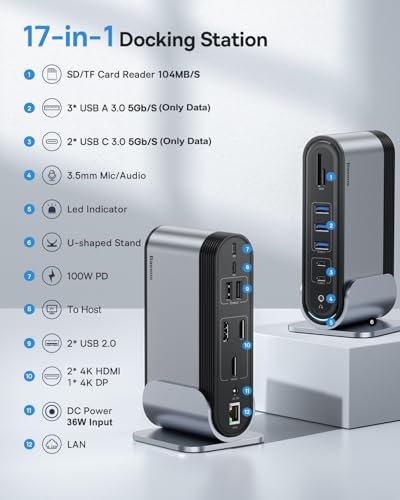
Seventeen ports, triple 4K, seven USB, Gigabit Ethernet, card readers, and a detachable stand that lets the dock sit upright or lay flat. The Baseus 17-in-1 covers every port type a desk setup needs in an aluminum body smaller than a paperback book. The included 36W adapter powers the dock itself. It does not charge the laptop. To charge the laptop through the dock, plug your own USB-C charger (up to 100W) into the PD port. Two cables at the desk: one for the dock, one for the laptop. That is how this dock works, and knowing it before purchase prevents the surprise of a laptop running on battery while everything else functions perfectly.
Seventeen ports. Three 4K HDMI/DP. Three USB-A 3.0. Two USB-C 3.0. Two USB-A 2.0. Gigabit Ethernet. 100W PD pass-through (charger not included). Card readers. Detachable stand. Aluminum. 5.1″ x 3.5″ x 1.2″. macOS and Windows. 1-year warranty.

Baseus 17-in-1 Laptop Docking Station 3 Monitors with 4K HDMI+DP, USB C Docking Station with 7 USB, 1000Mbps Ethernet, 100W PD, Card Readers Compatible with Acer/HP/Lenovo/Mac/Dell
Key Specifications
| Specification | Detail |
|---|---|
| Total Ports | 17 |
| HDMI/DP (4K) | 3 |
| USB-A 3.0 | 3 (5 Gbps) |
| USB-C 3.0 | 2 (5 Gbps) |
| USB-A 2.0 | 2 |
| Gigabit Ethernet | 1 (1000 Mbps) |
| Card Readers | Yes (per product title) |
| PD Pass-Through | 100W (charger not included) |
| Included Adapter | 36W (powers dock only, not laptop) |
| Detachable Stand | Yes |
| Enclosure | Aluminum |
| Dimensions | 5.1″ L x 3.5″ W x 1.2″ H |
| Weight | Not provided |
| Compatible OS | Windows 7/10, macOS |
| Compatible Devices | Acer, HP, Lenovo, Mac, Dell (USB-C) |
| Manufacturer | Baseus |
| Warranty | 1 year |
36W Adapter: Dock Power Only
The included 36W adapter powers the dock’s operations — driving three displays, seven USB ports, Ethernet, and card readers. It does not charge the laptop. To charge the laptop through the dock, connect a separate USB-C PD charger (up to 100W) to the dock’s PD input port. The dock passes that power through to the laptop while maintaining all port functions.

For a desk setup, this means two power cables: the 36W adapter for the dock and your laptop’s charger through the PD port. Most powered docks in this category use a single larger adapter (100-150W) that handles both dock and laptop from one plug. The Baseus splits that into two sources. The advantage: you can use any charger you already own through the PD port. The disadvantage: two power cables instead of one.
Triple 4K Display
Three HDMI/DP ports drive three 4K monitors simultaneously on Windows. For traders, developers, and anyone who spreads work across three screens, three 4K outputs cover the setup without resolution compromises. macOS display behavior depends on the Mac chip — base M-series Macs may be limited in external display count regardless of the dock’s capability.
Seven USB Ports at Mixed Speeds
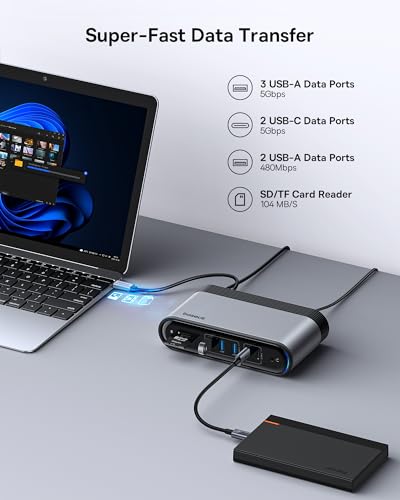
Three USB-A 3.0 at 5 Gbps for external drives and fast peripherals. Two USB-C 3.0 at 5 Gbps for modern USB-C accessories. Two USB-A 2.0 for keyboard and mouse. Seven USB ports covers a full desk: keyboard, mouse, webcam, headset, external drive, phone charging, and a spare. No 10 Gbps Gen 2 ports — all fast ports run at 5 Gbps.

Detachable Stand
The dock comes with a detachable stand that lets it sit upright or lay flat. Upright takes less desk surface. Flat provides more stability. The stand detaches without tools. For someone who moves between a standing desk and a traditional desk, the stand adapts to either arrangement. The Baseus Spacemate 11-in-1 stands vertically only. This 17-in-1 gives you the choice.
Drawbacks
| Consideration | Detail |
|---|---|
| 36W Adapter: Dock Only | Does not charge laptop. Separate charger needed through PD port. |
| Two Power Cables | Dock adapter + laptop charger. More cables than single-adapter docks. |
| USB 3.0, Not Gen 2 | 5 Gbps. No 10 Gbps ports. |
| Weight Not Provided | Cannot assess portability. |
| 1-Year Warranty | Shorter than some competitors at 18-24 months. |
Where the 17-in-1 Fits in Baseus’s Lineup
Baseus makes three docks: the 7-in-1 (compact travel hub), the Spacemate 11-in-1 (vertical tower, LED screen, screen-lock button, 85W pass-through), and this 17-in-1 (most ports, triple 4K, detachable stand, 36W dock-only adapter). The 17-in-1 has the highest port count and triple 4K. The Spacemate has the LED screen and screen-lock button. The 7-in-1 is the travel option. For the Baseus Spacemate, see the Baseus Spacemate review. For the Baseus 7-in-1, see the Baseus 7-in-1 review.
Who This Dock Is For
Users who need 17 ports with triple 4K, seven USB, Ethernet, card readers, and a detachable stand from Baseus, and who already own a USB-C PD charger for their laptop: The 17-in-1 provides the port count. The 36W adapter keeps the dock powered. Your own charger through the PD port keeps the laptop powered. If you already carry a 65-100W charger, the dock adds 17 ports to that charger’s capability. Aluminum build. Detachable stand. 1-year warranty.
Buyers who want one adapter that powers everything, or who need 10 Gbps USB: Two power cables required. All USB at 5 Gbps. For a single-adapter dock, the TobenONE 15-port (150W) or Acer 14-in-1 (110W) provide that. See the docking stations hub page.
Final Verdict
Seventeen ports in aluminum with a detachable stand, triple 4K, seven USB, Gigabit Ethernet, and card readers. Bring your own laptop charger for PD pass-through. The dock provides every port type a desk needs. The buyer provides the wattage for the laptop. For the person who already carries a 65-100W USB-C charger and wants the dock with the highest port count from Baseus, the 17-in-1 handles the connectivity while the charger handles the power.
Frequently Asked Questions
Does the included adapter charge my laptop?
No. The 36W adapter powers the dock only. To charge the laptop, connect your own USB-C PD charger (up to 100W) to the dock’s PD input port.
How many monitors can I connect?
Three 4K monitors through the HDMI/DP ports on Windows. Mac display count depends on the chip.
Can the stand be removed?
Yes. The stand detaches without tools. The dock works flat or upright.
How is this different from the Baseus Spacemate?
The 17-in-1 has more ports (17 vs 11), triple 4K (vs triple 4K), and a detachable stand. The Spacemate has an LED status screen and a screen-lock button that the 17-in-1 does not. The Spacemate passes through 85W from your charger. The 17-in-1 passes through 100W but uses a separate 36W adapter for the dock itself.
Disclosure: As an Amazon Associate, I earn from qualifying purchases.

I evaluate docking stations the way they actually get used — against real bandwidth budgets, power-delivery ceilings, and the OS handshakes that quietly cap what a port can do — not spec-sheet promises. Every constraint that can break a multi-display setup is disclosed before any affiliate link.
Docking Station Intelligence
The standards are confusing by design. These three panels decode what manufacturers won’t explain clearly. Applicable to every docking station.
The USB-C Confusion Matrix
The USB-C connector is the single greatest source of buyer confusion in docking stations. The physical plug looks identical whether it carries USB 2.0 at 480 Mbps or Thunderbolt 5 at 120 Gbps — a 250x difference in capability hidden behind the same shape. Manufacturers exploit this by labeling everything "USB-C compatible" without specifying which protocol runs through it. Two docks can look identical on the outside and behave completely differently once you plug them in.
The hierarchy matters because it determines everything: how many monitors your dock can drive, how fast files transfer, whether your laptop charges while docked, and whether you need third-party drivers. Here is the real capability ladder, from slowest to fastest:
The practical takeaway: if your laptop has Thunderbolt 4, buy a Thunderbolt dock. If it only has generic USB-C, verify whether it supports DisplayPort Alt Mode before buying anything with multi-monitor claims. Our buying guide walks through verification steps for every major laptop brand.
Power Delivery: What the Watts Mean
Power Delivery (PD) determines whether your docking station can charge your laptop while you work, or whether you need a separate charger cluttering your desk. The math is simple but rarely explained: your laptop draws a specific wattage under load, and the dock must match or exceed it. If the dock delivers less than your laptop needs, the battery slowly drains even while plugged in — defeating the purpose of a docking station entirely.
Most ultrabooks need 45–65W. Standard business laptops need 65–100W. Gaming and workstation laptops can demand 100–140W or more. The dock’s advertised PD wattage is the maximum it can deliver to your laptop — but this drops if you charge other devices (phones, tablets) through the dock simultaneously. Always leave a 15–20W margin above your laptop’s requirement.
Check your laptop’s original charger wattage — that’s your baseline. Our FAQ covers how to find this for every major brand.
Native Display vs DisplayLink: The Hidden Factor
This is the decision most buyers don’t know they’re making. When a docking station outputs video to your monitors, it uses one of two fundamentally different methods: native (the dock passes your laptop’s GPU signal directly to the monitor) or DisplayLink (the dock compresses video over USB and a software driver renders it). The difference is invisible in marketing materials but profoundly affects your daily experience.
Native output through DisplayPort Alt Mode or Thunderbolt uses your laptop’s actual graphics hardware. There is zero added latency, full DRM support for streaming services, no CPU overhead, and no driver to install. DisplayLink, by contrast, adds 5–15ms of latency (noticeable in video calls and cursor movement), blocks DRM content on connected monitors (Netflix, Disney+ show black screens), consumes 3–8% of your CPU constantly, and requires a driver that Apple’s macOS security updates occasionally break.
DisplayLink exists for one reason: Apple Silicon base chips (M1, M2, M3) can only drive one external display natively. If you need two or more monitors on a base MacBook Air or 13” MacBook Pro, DisplayLink is your only option. For everyone else — Windows users, Mac Pro/Max chip users, Intel/AMD laptops — native is always the better choice.
Native (Alt Mode / Thunderbolt)
DisplayLink (USB compression)
The bottom line: if your laptop supports native multi-display output, always choose a native dock. DisplayLink is a workaround, not an upgrade. See our glossary for detailed definitions.
COMMAND CENTERCOMMAND CENTER
Six tools that decode the confusion manufacturers create. Port protocols, power budgets, display configurations, compatibility, desk planning, and future-proofing. Full buying guide →
Port Protocol DecoderWhat does your connection type actually support? Glossary
Power Delivery CalculatorCan this dock keep your laptop charged?
Display Configuration PlannerCan your dock push enough pixels?
Laptop-to-Dock CompatibilityWill this dock work with YOUR laptop?
Desk Setup ArchitectWhat ports do you actually need?
Select everything you need to connect: