
iVANKY Laptop Docking Station Review
Boost laptop connectivity with the iVANKY Docking Station. Dual 4K monitors, 85W charging, 12 ports—it’s the Swiss Army knife of docks. Perfect for multitaskers!
Have you ever wondered how you could make the most out of your laptop’s connectivity with a single device? I stumbled upon the iVANKY Laptop Docking Station Dual Monitor 4K@60Hz, a mouthful, I know, but boy is it packed to the gills with all the connections I’ve ever dreamed of. It’s as if someone asked, “How many functions can we squeeze into a docking station?” and then went ahead and did just that.
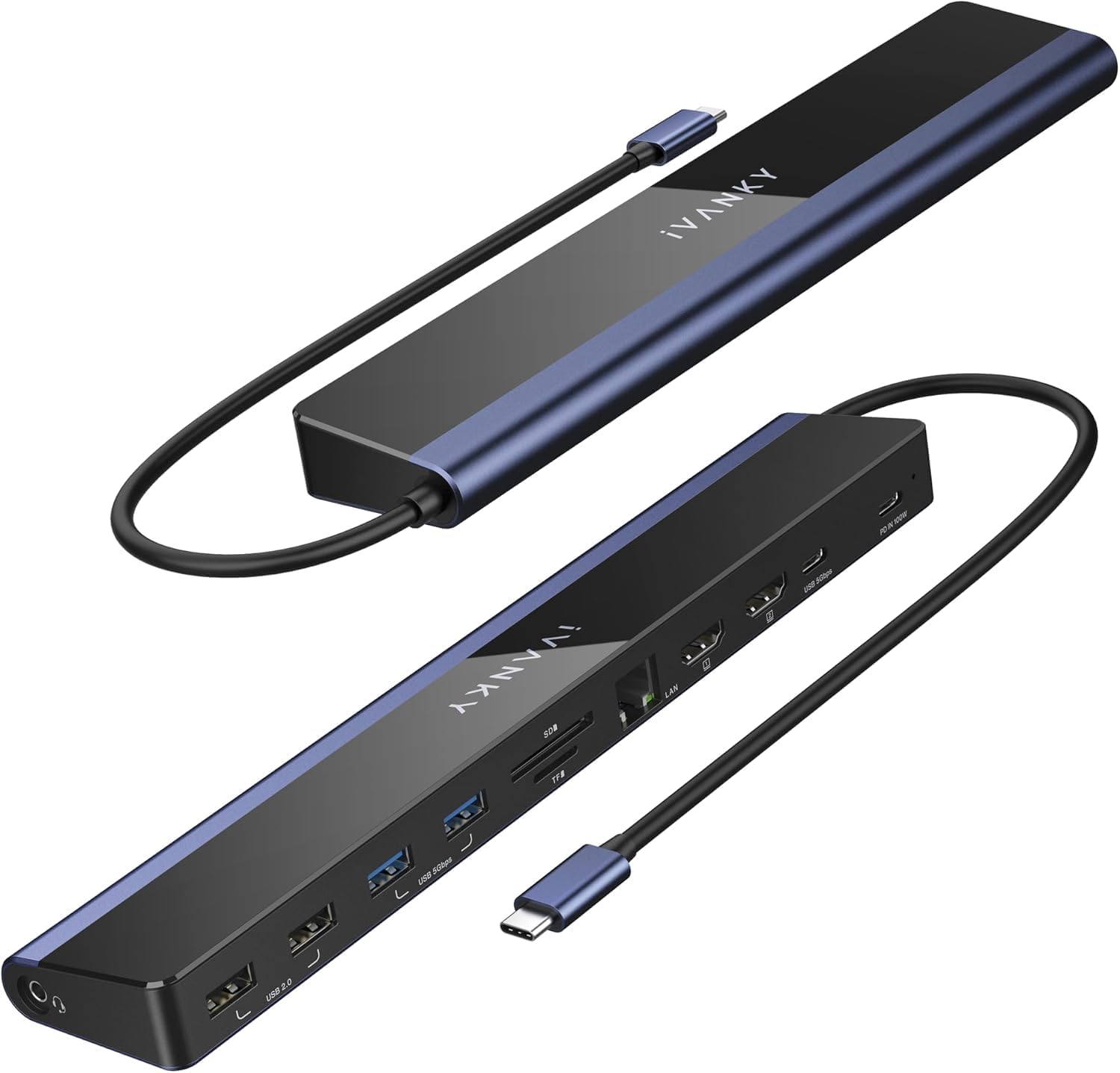

Unpacking Versatility: The 12-In-1 Marvel
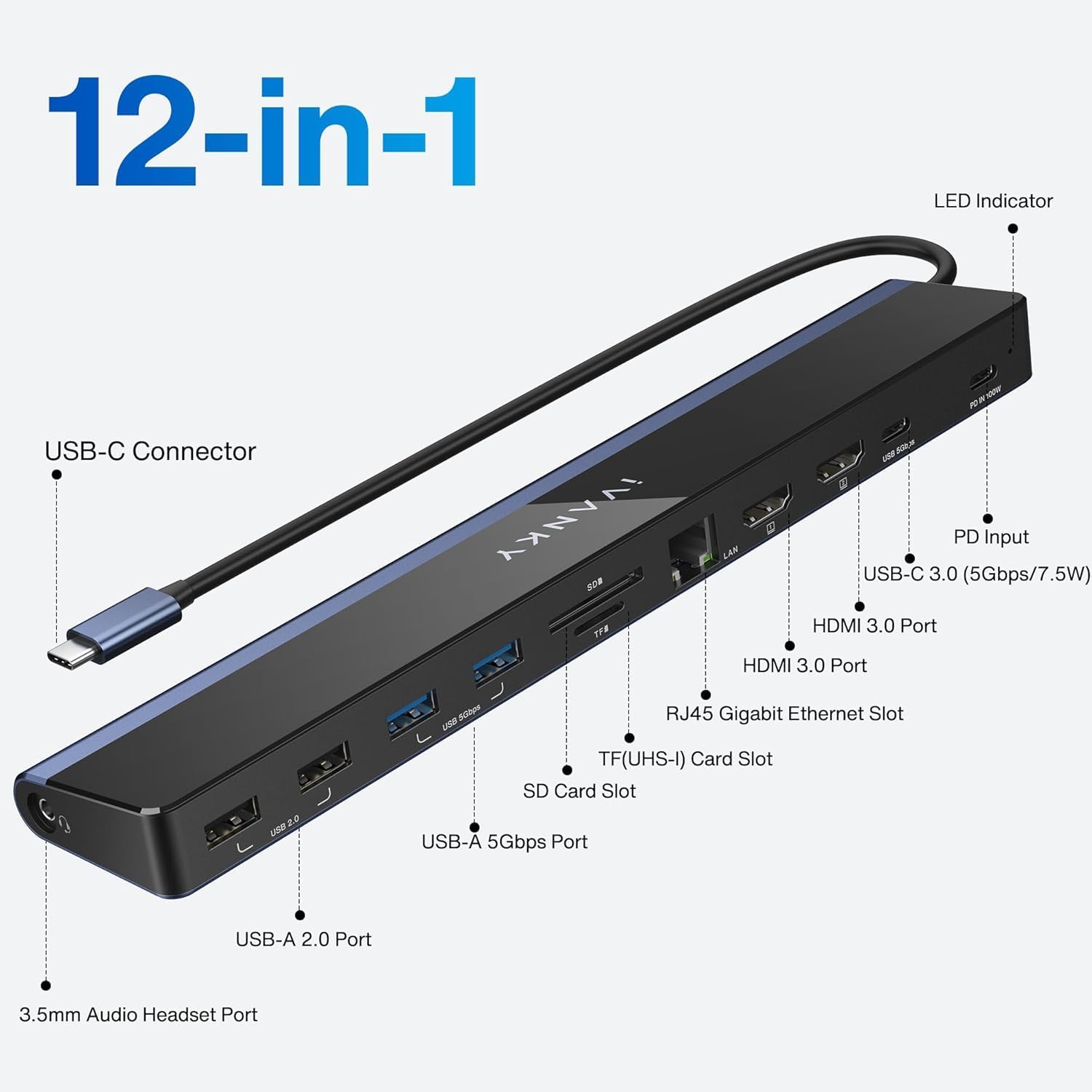
Picture a Swiss Army knife, but for laptops. That’s essentially what the iVANKY Docking Station offers. With 12 different types of ports, you’re basically prepared for anything. Need to connect dual monitors? Sorted. Transferring files with your USB drive? Easy. How about charging your laptop while you’re connecting to the Ethernet? No problemo.
Dual Monitor 4K@60Hz: A Feast for the Eyes
Why settle for one screen when two are so much better? The dual HDMI ports let you connect two monitors in 4K at a buttery 60Hz. And would you believe it? No additional driver downloads required. I mean, in this day and age, who has the time for that? It’s like having a mini cinema or digital art studio at your desk. Whether you’re designing graphics or just want that extra screen real estate while bingeing Netflix—dual monitors are a game-changer.
Power and Simplicity: 85W Charging Capability
Now, here’s something every laptop user can appreciate—85 watts of charging power. That’s enough juice to ensure your laptop stays alive even during the most intense work sessions. And oh, don’t fret if you’re simultaneously charging your phone or tablet. The dock keeps up, even if your devices demand quite a bit of power.
Lightning-fast Data Transfer: USB Galore
Get this, the station features three USB 3.0 and two USB 2.0 ports. That’s five ports ready to cater to every data-transfer whim. Speeding through files at up to 5Gbps, it’s faster than most people wait for their coffee to brew. And don’t forget the SD/TF slots with a brisk 104Mb/s transfer speed. Who knew file transfers could be this painless?
| Port Type | Quantity | Max Speed |
|---|---|---|
| USB 3.0 | 3 | Up to 5Gbps |
| USB 2.0 | 2 | For peripherals |
| HDMI Ports | 2 | 4K@60Hz |
| Ethernet | 1 | 1000Mbps |
| SD/TF Slot | 1 each | 104Mb/s |
Gigabit Ethernet: Say Goodbye to Latency
Remember the days of buffering? With the RJ45 Gigabit Ethernet port, those days are safely behind us. It promises a smooth and stable 1000Mbps Ethernet connection. So, whether you’re hosting a webinar or losing yourself in online gaming, lag shouldn’t haunt you anymore.

iVANKY Laptop Docking Station Dual Monitor 4K@60Hz, 12-in-1 USB C Dock 2*HDMI 3.0, 6*USB, 85W PD, SD/TF, Ethernet Thunderbolt 3/4 Hub for HP, Lenovo, Dell, ASUS,Surface, etc.
Seamless Integration with Your Devices
Before you let excitement get the better of you, just a little reminder. Make sure your laptop’s USB-C port supports video transfer, data transfer, and charging. It’s a bit of a formality, but worth checking to avoid potential hiccups. Think of it like sizing up a pair of shoes before you hit the checkout counter.
Easy Setup with No Driver Hassles
I remember plugging in my dongle, expecting a tedious driver installation. But instead, it worked right out of the box! It’s like discovering an almond inside a waffle cone when you expected just plain vanilla. Pure joy and a little surprise, to say the least.
Assured Quality with a 24-Month Warranty
What’s better than a product that promises to meet your expectations? One that backs it with a 24-month warranty and killer customer service. It’s as if they have a team of superhero tech support folks waiting to swoop in if you need them. Plus, they’re quick—answering within 24 hours during weekdays. It’s that peace of mind that makes you wonder why you bothered with anything else.
Real-World Applications: Mastering the Multitask
Imagine the peace of having a workstation that can juggle a variety of tasks. It’s like observing a symphony conductor, but with less risk of going deaf from all the cymbals. Whether you’re at home, in the office, or at your favorite cafe, this docking station seems to shout, “Bring it on!”
Enhancing Productivity: From Work to Play
Let’s face it. Most of us have to slip between work and play more times in a day than we care to admit. With dual monitors, handle your social media on one and spreadsheets on the other. Or, for those spontaneous Zoom calls, the steady Ethernet connection makes lagging almost non-existent.
Streamlined Connectivity: Everything and Anything
If your desk looks like someone tried knotting all the cables into a decorative macrame piece, this gadget might just be your savior. It helps untangle your setup, meaning more time enjoying the seamless productivity and less time untangling. Plug all your gizmos into it and voilà—it’s literally organized chaos at its best.
Compatibility Across the Board
Whether your laptop is from the realms of HP, Dell, Lenovo, or Asus, the iVANKY Docking Station doesn’t pick favorites. It aligns itself like a chameleon with Thunderbolt 3 and 4. Are you using a Surface? Fear not, for this docking station nods in approval.
Final Verdict: Is It Worth Your Desk Space?
I’ll confess, at the end of the day, the iVANKY Docking Station has nestled quite comfortably into my workspace—maybe too comfortably. For anyone juggling multiple devices or needing the extra screen space, it’s become something of an indispensable ally. Its ease of setup, coupled with the versatility across various functionalities, makes it a worthy contender for any tech-savvy individual.
Overall Impression: A Dock Above the Rest
In conclusion, if this docking station were a person—it’d surely win the popularity contest among its peers. Its multifaceted nature wrapped in a sleek, user-friendly design checks all the boxes I never knew existed. It’s not just another dock—it’s the dock. So if you’re out hunting for the perfect accessory for your multitasking needs, maybe give this a go. Who knows, it might just change the way you work and play.
Disclosure: As an Amazon Associate, I earn from qualifying purchases.
Docking Station Intelligence
The standards are confusing by design. These three panels decode what manufacturers won’t explain clearly. Applicable to every docking station.
The USB-C Confusion Matrix
The USB-C connector is the single greatest source of buyer confusion in docking stations. The physical plug looks identical whether it carries USB 2.0 at 480 Mbps or Thunderbolt 5 at 120 Gbps — a 250x difference in capability hidden behind the same shape. Manufacturers exploit this by labeling everything "USB-C compatible" without specifying which protocol runs through it. Two docks can look identical on the outside and behave completely differently once you plug them in.
The hierarchy matters because it determines everything: how many monitors your dock can drive, how fast files transfer, whether your laptop charges while docked, and whether you need third-party drivers. Here is the real capability ladder, from slowest to fastest:
The practical takeaway: if your laptop has Thunderbolt 4, buy a Thunderbolt dock. If it only has generic USB-C, verify whether it supports DisplayPort Alt Mode before buying anything with multi-monitor claims. Our buying guide walks through verification steps for every major laptop brand.
Power Delivery: What the Watts Mean
Power Delivery (PD) determines whether your docking station can charge your laptop while you work, or whether you need a separate charger cluttering your desk. The math is simple but rarely explained: your laptop draws a specific wattage under load, and the dock must match or exceed it. If the dock delivers less than your laptop needs, the battery slowly drains even while plugged in — defeating the purpose of a docking station entirely.
Most ultrabooks need 45–65W. Standard business laptops need 65–100W. Gaming and workstation laptops can demand 100–140W or more. The dock’s advertised PD wattage is the maximum it can deliver to your laptop — but this drops if you charge other devices (phones, tablets) through the dock simultaneously. Always leave a 15–20W margin above your laptop’s requirement.
Check your laptop’s original charger wattage — that’s your baseline. Our FAQ covers how to find this for every major brand.
Native Display vs DisplayLink: The Hidden Factor
This is the decision most buyers don’t know they’re making. When a docking station outputs video to your monitors, it uses one of two fundamentally different methods: native (the dock passes your laptop’s GPU signal directly to the monitor) or DisplayLink (the dock compresses video over USB and a software driver renders it). The difference is invisible in marketing materials but profoundly affects your daily experience.
Native output through DisplayPort Alt Mode or Thunderbolt uses your laptop’s actual graphics hardware. There is zero added latency, full DRM support for streaming services, no CPU overhead, and no driver to install. DisplayLink, by contrast, adds 5–15ms of latency (noticeable in video calls and cursor movement), blocks DRM content on connected monitors (Netflix, Disney+ show black screens), consumes 3–8% of your CPU constantly, and requires a driver that Apple’s macOS security updates occasionally break.
DisplayLink exists for one reason: Apple Silicon base chips (M1, M2, M3) can only drive one external display natively. If you need two or more monitors on a base MacBook Air or 13” MacBook Pro, DisplayLink is your only option. For everyone else — Windows users, Mac Pro/Max chip users, Intel/AMD laptops — native is always the better choice.
Native (Alt Mode / Thunderbolt)
DisplayLink (USB compression)
The bottom line: if your laptop supports native multi-display output, always choose a native dock. DisplayLink is a workaround, not an upgrade. See our glossary for detailed definitions.
COMMAND CENTERCOMMAND CENTER
Six tools that decode the confusion manufacturers create. Port protocols, power budgets, display configurations, compatibility, desk planning, and future-proofing. Full buying guide →
Port Protocol DecoderWhat does your connection type actually support? Glossary
Power Delivery CalculatorCan this dock keep your laptop charged?
Display Configuration PlannerCan your dock push enough pixels?
Laptop-to-Dock CompatibilityWill this dock work with YOUR laptop?
Desk Setup ArchitectWhat ports do you actually need?
Select everything you need to connect: