
JSAUX Docking Station Review
Uncover the magic of gaming with the JSAUX Docking Station—your knight in sleek armor. Seamless play, stunning visuals, and ultimate connectivity await!
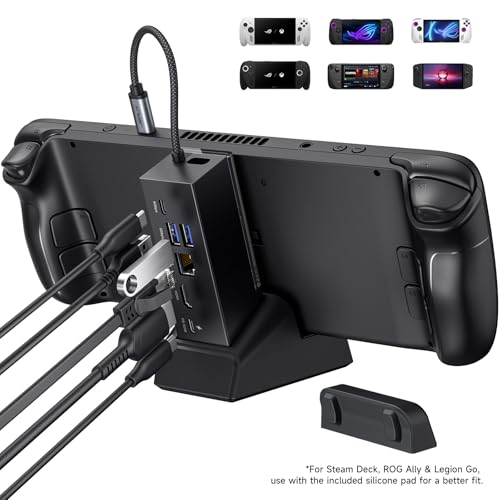
ROG Ally on the dock, HDMI cable running to the TV at 4K@120Hz, a controller plugged in through USB, and the handheld charging at 100W while you play. The JSAUX HB0609 is a 6-in-1 gaming handheld dock with a modular stand, DIY custom card slot, and compatibility across ROG Ally, ROG Xbox Ally (2025), Steam Deck, Legion Go, and more. At 0.27 kg (9.5 oz) and 3.35″ x 1.93″ x 4.92″, it is compact enough for travel and sturdy enough for a permanent desk setup. Manufactured by Shenzhen Wuyishi Technology Co., Ltd.

JSAUX Docking Station for ROG Xbox Ally X (2025)/ROG Ally X/ROG Ally/Steam Deck/Legion Go/Legion Go S, 6-in-1 Dock with HDMI 4K@120Hz, Gigabit Ethernet, USB A & USB C 3.2 Gen 1, 100W Charging - HB0609
Key Specifications
| Specification | Detail |
|---|---|
| Total Ports | 6 |
| HDMI | 1 (4K@120Hz / 1080p@240Hz) |
| USB-A 3.2 Gen 1 | 2 |
| USB-C 3.2 Gen 1 | 1 |
| USB-C PD | 1 (100W max) |
| Gigabit Ethernet | 1 |
| VRR/ALLM | Not supported (HB0705 model needed) |
| Compatible Devices | ROG Xbox Ally X (2025), ROG Xbox Ally (2025), ROG Ally X, ROG Ally, Steam Deck LCD/OLED, Legion Go, Legion Go S, Razer Edge, AYA NEO, AYA ODIN, Logitech G Cloud, ONEXPLAYER |
| Modular Stand | Detachable base for desktop or portable use |
| DIY Custom Card | Slot for personalized card (3.00″ x 1.13″ x 0.01″, not included) |
| Weight | 0.27 kg / 9.5 oz |
| Dimensions | 3.35″ L x 1.93″ W x 4.92″ H |
| Manufacturer | Shenzhen Wuyishi Technology Co., Ltd. |
| Warranty | Not specified in Amazon data |
The 65W Charger Warning
The first Amazon bullet contains an important charging note: when the ROG Xbox Ally or ROG Xbox Ally X connects to the dock, the dock consumes part of the input power. Using the original 65W charger may trigger the message “Not enough power to charge efficiently.” Gameplay is not affected, but charging is slower and overall charging time is longer. JSAUX recommends a 100W PD charger for optimal performance.

This means the dock’s 100W PD port needs a 100W charger to deliver full-speed charging to the handheld. A 65W charger works but the handheld charges slowly during play. If you own a 100W USB-C PD charger, you avoid the warning entirely. If you only have the original 65W, budget for a 100W charger to get the most from this dock.
Comprehensive Device Support
The compatibility list has expanded since this product launched. Current supported devices include ROG Xbox Ally X (2025), ROG Xbox Ally (2025), ROG Ally X, ROG Ally, Steam Deck LCD and OLED, Legion Go, Legion Go S, Razer Edge, AYA NEO, AYA ODIN, Logitech G Cloud, and ONEXPLAYER. That is the broadest handheld gaming dock compatibility list on this site, covering both major and niche handhelds.
| Compatible Device | Key Features Available |
|---|---|
| ROG Ally X / ROG Ally | 100W Charging, HDMI 4K@120Hz, Ethernet |
| ROG Xbox Ally X (2025) / ROG Xbox Ally (2025) | 100W Charging, HDMI 4K@120Hz (65W charger triggers warning) |
| Steam Deck LCD/OLED | USB-C 3.2 Gen 1, Ethernet, HDMI, PD Charging (max 45W) |
| Legion Go / Legion Go S | Dual USB-A 3.2 Gen 1, PD Charging, HDMI |
| Razer Edge, AYA NEO, AYA ODIN, Logitech G Cloud, ONEXPLAYER | HDMI, Ethernet, USB, PD Charging |
Modular Design
The base detaches from the dock for standalone use as a stand. With the base attached, the handheld sits upright on the dock for desktop play. With the base detached, the dock functions as a portable hub. The included silicone pad provides grip and stability, preventing the handheld from slipping during play. The modular approach means one dock adapts to both permanent desk setups and travel configurations.

DIY Custom Card
The front cover removes to reveal a slot for a custom card. Recommended card size: 3.00″ x 1.13″ x 0.01″ (76.3mm x 28.7mm x 0.3mm). Custom cards are not included. Insert artwork, a team logo, or a personal design to make the dock visually yours. The cover snaps back on over the card.
HDMI Output: 4K@120Hz and 1080p@240Hz
The HDMI output supports 4K@120Hz for high-resolution gaming visuals and 1080p@240Hz for competitive titles where frame rate matters more than resolution. The resolution and frame rate you achieve depend on the handheld’s GPU capability and the game. ROG Ally X pushes higher frame rates than Steam Deck in most titles. The dock supports whatever the handheld can output up to its maximum.
Important: this dock model (HB0609) does not support VRR (Variable Refresh Rate) or ALLM (Auto Low Latency Mode). For VRR and ALLM, JSAUX offers the HB0705 model with RGB fan cooling. If VRR matters for your gaming experience (adaptive sync to reduce screen tearing), the HB0609 is not the right model.
Gigabit Ethernet for Online Play
The Gigabit Ethernet port provides wired network for online multiplayer. WiFi on handheld gaming devices introduces latency spikes and packet loss that competitive games punish. Wired Ethernet eliminates those issues. For single-player games played offline, Ethernet is unnecessary. For online multiplayer where consistent ping matters, the wired connection is the reason to dock instead of playing handheld.

Drawbacks
| Consideration | Detail |
|---|---|
| 65W Charger Warning | ROG Xbox Ally triggers “not enough power” message. 100W recommended. |
| No VRR/ALLM | HB0705 model needed for those features. |
| USB 3.2 Gen 1, Not Gen 2 | 5 Gbps, not 10 Gbps. |
| Custom Card Not Included | DIY slot is empty. You supply the card. |
| Warranty Not Specified | Amazon data does not list warranty duration. |
Who This Dock Is For
Handheld gaming console owners who want a modular dock with 4K@120Hz, Gigabit Ethernet, 100W charging, and the broadest device compatibility: The JSAUX HB0609 supports more handheld devices than any other gaming dock on this site. The modular stand adapts to desk and travel. The DIY card slot adds personalization. 4K@120Hz and 1080p@240Hz cover both cinematic and competitive gaming. Pair it with a 100W charger for the best experience. For a gaming dock with a foldable stand and higher refresh rate support, see the UGREEN Steam Deck Dock review.
Gamers who need VRR/ALLM or 10 Gbps USB: This model does not support VRR or ALLM. USB runs at 5 Gbps Gen 1. For VRR support, JSAUX offers the HB0705 model. For 10 Gbps USB, the UGREEN Steam Deck Dock provides that. See our docking stations hub page.
Final Verdict
The JSAUX HB0609 provides six ports, modular design, DIY customization, and the widest handheld compatibility list on this site in a 9.5 oz package. The 4K@120Hz HDMI, Gigabit Ethernet, and 100W PD cover the core docking needs. The 65W charger warning and lack of VRR/ALLM are the honest limitations. For handheld gamers who want one dock that works with every major handheld on the market and offers a personal touch through the custom card slot, the JSAUX delivers that combination.
Frequently Asked Questions
Why does my ROG Xbox Ally say “not enough power”?
The dock consumes part of the input power. A 65W charger triggers the warning because not enough power remains for full-speed charging during play. Use a 100W PD charger to eliminate the message and charge at full speed.
Does this support VRR?
No. The HB0609 model does not support VRR or ALLM. For VRR support, choose the JSAUX HB0705 model (listed as “Black-RGB Fan Cooling” on Amazon).
What size is the custom card?
3.00″ x 1.13″ x 0.01″ (76.3mm x 28.7mm x 0.3mm). Cards are not included. You create or print your own.
How does this compare to the UGREEN Steam Deck Dock?
JSAUX: 6 ports, modular stand, DIY card slot, 5 Gbps USB, no VRR, broadest handheld compatibility. UGREEN: 9 ports, foldable stand, 10 Gbps USB, SD/TF readers, no DIY customization. Choose JSAUX for customization and wider device support. Choose UGREEN for more ports and faster USB.
Disclosure: As an Amazon Associate, I earn from qualifying purchases.

I evaluate docking stations the way they actually get used — against real bandwidth budgets, power-delivery ceilings, and the OS handshakes that quietly cap what a port can do — not spec-sheet promises. Every constraint that can break a multi-display setup is disclosed before any affiliate link.
Docking Station Intelligence
The standards are confusing by design. These three panels decode what manufacturers won’t explain clearly. Applicable to every docking station.
The USB-C Confusion Matrix
The USB-C connector is the single greatest source of buyer confusion in docking stations. The physical plug looks identical whether it carries USB 2.0 at 480 Mbps or Thunderbolt 5 at 120 Gbps — a 250x difference in capability hidden behind the same shape. Manufacturers exploit this by labeling everything "USB-C compatible" without specifying which protocol runs through it. Two docks can look identical on the outside and behave completely differently once you plug them in.
The hierarchy matters because it determines everything: how many monitors your dock can drive, how fast files transfer, whether your laptop charges while docked, and whether you need third-party drivers. Here is the real capability ladder, from slowest to fastest:
The practical takeaway: if your laptop has Thunderbolt 4, buy a Thunderbolt dock. If it only has generic USB-C, verify whether it supports DisplayPort Alt Mode before buying anything with multi-monitor claims. Our buying guide walks through verification steps for every major laptop brand.
Power Delivery: What the Watts Mean
Power Delivery (PD) determines whether your docking station can charge your laptop while you work, or whether you need a separate charger cluttering your desk. The math is simple but rarely explained: your laptop draws a specific wattage under load, and the dock must match or exceed it. If the dock delivers less than your laptop needs, the battery slowly drains even while plugged in — defeating the purpose of a docking station entirely.
Most ultrabooks need 45–65W. Standard business laptops need 65–100W. Gaming and workstation laptops can demand 100–140W or more. The dock’s advertised PD wattage is the maximum it can deliver to your laptop — but this drops if you charge other devices (phones, tablets) through the dock simultaneously. Always leave a 15–20W margin above your laptop’s requirement.
Check your laptop’s original charger wattage — that’s your baseline. Our FAQ covers how to find this for every major brand.
Native Display vs DisplayLink: The Hidden Factor
This is the decision most buyers don’t know they’re making. When a docking station outputs video to your monitors, it uses one of two fundamentally different methods: native (the dock passes your laptop’s GPU signal directly to the monitor) or DisplayLink (the dock compresses video over USB and a software driver renders it). The difference is invisible in marketing materials but profoundly affects your daily experience.
Native output through DisplayPort Alt Mode or Thunderbolt uses your laptop’s actual graphics hardware. There is zero added latency, full DRM support for streaming services, no CPU overhead, and no driver to install. DisplayLink, by contrast, adds 5–15ms of latency (noticeable in video calls and cursor movement), blocks DRM content on connected monitors (Netflix, Disney+ show black screens), consumes 3–8% of your CPU constantly, and requires a driver that Apple’s macOS security updates occasionally break.
DisplayLink exists for one reason: Apple Silicon base chips (M1, M2, M3) can only drive one external display natively. If you need two or more monitors on a base MacBook Air or 13” MacBook Pro, DisplayLink is your only option. For everyone else — Windows users, Mac Pro/Max chip users, Intel/AMD laptops — native is always the better choice.
Native (Alt Mode / Thunderbolt)
DisplayLink (USB compression)
The bottom line: if your laptop supports native multi-display output, always choose a native dock. DisplayLink is a workaround, not an upgrade. See our glossary for detailed definitions.
COMMAND CENTERCOMMAND CENTER
Six tools that decode the confusion manufacturers create. Port protocols, power budgets, display configurations, compatibility, desk planning, and future-proofing. Full buying guide →
Port Protocol DecoderWhat does your connection type actually support? Glossary
Power Delivery CalculatorCan this dock keep your laptop charged?
Display Configuration PlannerCan your dock push enough pixels?
Laptop-to-Dock CompatibilityWill this dock work with YOUR laptop?
Desk Setup ArchitectWhat ports do you actually need?
Select everything you need to connect: