
Docking Stations & Portable Monitors: The Ultimate Travel Setup
Traveling can be chaotic, but not with docking stations and portable monitors. Discover how these tech companions can keep you productive and entertained on the go.
Have you ever embarked on a journey and felt the need for a more efficient way to maintain your productivity while on the go? Let’s admit it: packing all unintentional chaos into a compact suitcase can be daunting. Yet, we cannot ignore the gadgets that silently ensure our experiences are seamless, whether during travel or when transitioning from place to place. Therefore, the magic lies in our travel setup, notably docking stations and portable monitors.
Docking stations and portable monitors sound like jargon until they transform our travels into productive and enjoyable adventures. As we delve into the necessity, adaptability, and seamless functionality of these travel companions, it’s easy to lose ourselves in their technicality. But worry not! We’re here to journey through this realm together, breaking down product types, features, connectivity, and ultimate benefits. Our goal is to make every trip technologically equipped while maintaining that friendly traveler’s touch.
Understanding Docking Stations
When we first hear “docking station,” we might picture some space-age device that requires degrees in engineering to operate. Fortunately, docking stations are simpler and more intuitive than they sound. Essentially, they act as a bridge, a master multitasker that connects our laptops to various devices, increasing their functionality and versatility.
Why Choose a Docking Station?
Docking stations quickly turn the average laptop into a powerful workstation, essential for a traveler who longs for the convenience of their home setup while being away. They support multiple peripherals—think keyboards, mice, external hard drives, or even printers—without requiring multiple adaptors or a tangle of cords. This handy gadget can transform our travel experiences, making sure we don’t compromise on productivity or connectivity.
Key Features of Docking Stations
Understanding the prominent features of docking stations gives us an edge when trying to select the one best suited for our needs. Let’s break these down:
- Port Variety: The more, the merrier. A docking station with various ports (USB-C, USB-A, HDMI, DisplayPort, Ethernet, etc.) can significantly enhance our device’s connectivity.
- Power Delivery: Look for docking stations capable of charging your device while simultaneously expanding its port utility.
- Compatibility: Ensure the docking station is compatible with your laptop’s operating system and hardware requirements, preventing one of those dreaded gadget incompatibility nightmares.
- Portability: Don’t be fooled by size; newer models come lightweight yet powerful, making them suitable for travel.
Top Docking Station Picks
To guide you through the plethora of options available, here’s a brief guide to some traveler-friendly models:
| Docking Station Model | Ports Available | Best Feature |
|---|---|---|
| CalDigit TS3 Plus | Thunderbolt 3, USB-A, SD Card | Power Delivery |
| Anker PowerExpand | USB-C, HDMI, Ethernet | Compact Design |
| Kensington SD5700T | Thunderbolt 4, USB-C | High Data Transfer Rate |
| Plugable UD-6950H | Dual 4K HDMI/DVI Outputs | Versatile Video Outputs |
Exploring Portable Monitors
A portable monitor is the friend we never knew we needed until we’re crammed next to a fellow passenger on an impossibly-small airplane tray table. These svelte screens can boost our productivity by offering a dual-screen setup, even when we’re continents away from home. Like a good friend, they can balance professional demands while allowing us to enjoy a movie or show on those less-busy travel nights.
Why Invest in a Portable Monitor?
We may wonder why a portable monitor is a worthy investment compared to conventional monitors. The answer is simple: flexibility and productivity enhancement without compromising space or quality. In our fast-paced world, where efficiency is invaluable, having an extended screen can significantly ease multitasking. From video editing to coding, a second screen streamlines the workflow, effectively doubling our visual workspace.
Key Features of Portable Monitors
We can ensure our portable monitor selection complements our travel needs by familiarizing ourselves with relevant features.
- Screen Resolution: A high-resolution screen ensures quality imagery and text rendering—essential for those late-night, detail-oriented projects.
- Connectivity Options: Weighting towards models with USB-C ports can enable a more streamlined connection without unnecessary adaptors.
- Adjustability & Stand Options: Versatile stand options and tilt adjustments can make viewing and transport considerably more comfortable.
- Weight & Durability: Lightweight yet resilient models are ideal for enduring travel bumps without adding bulk to our luggage.
Top Portable Monitor Picks
Let’s glance at some fan-favorite portable monitors where productivity meets portability:
| Portable Monitor Model | Resolution | Most Attractive Feature |
|---|---|---|
| ASUS ZenScreen MB16AC | 1080p Full HD | Lightweight Design |
| Lenovo ThinkVision M14 | 1920×1080 (IPS) | Ultra-Light and Sleek Look |
| AOC e1659Fwu | 15.6-Inch, USB 3.0 | Easy Setup with Foldable Stand |
| HP EliteDisplay S14 | 1920 x 1080 | USB-C Connectivity |
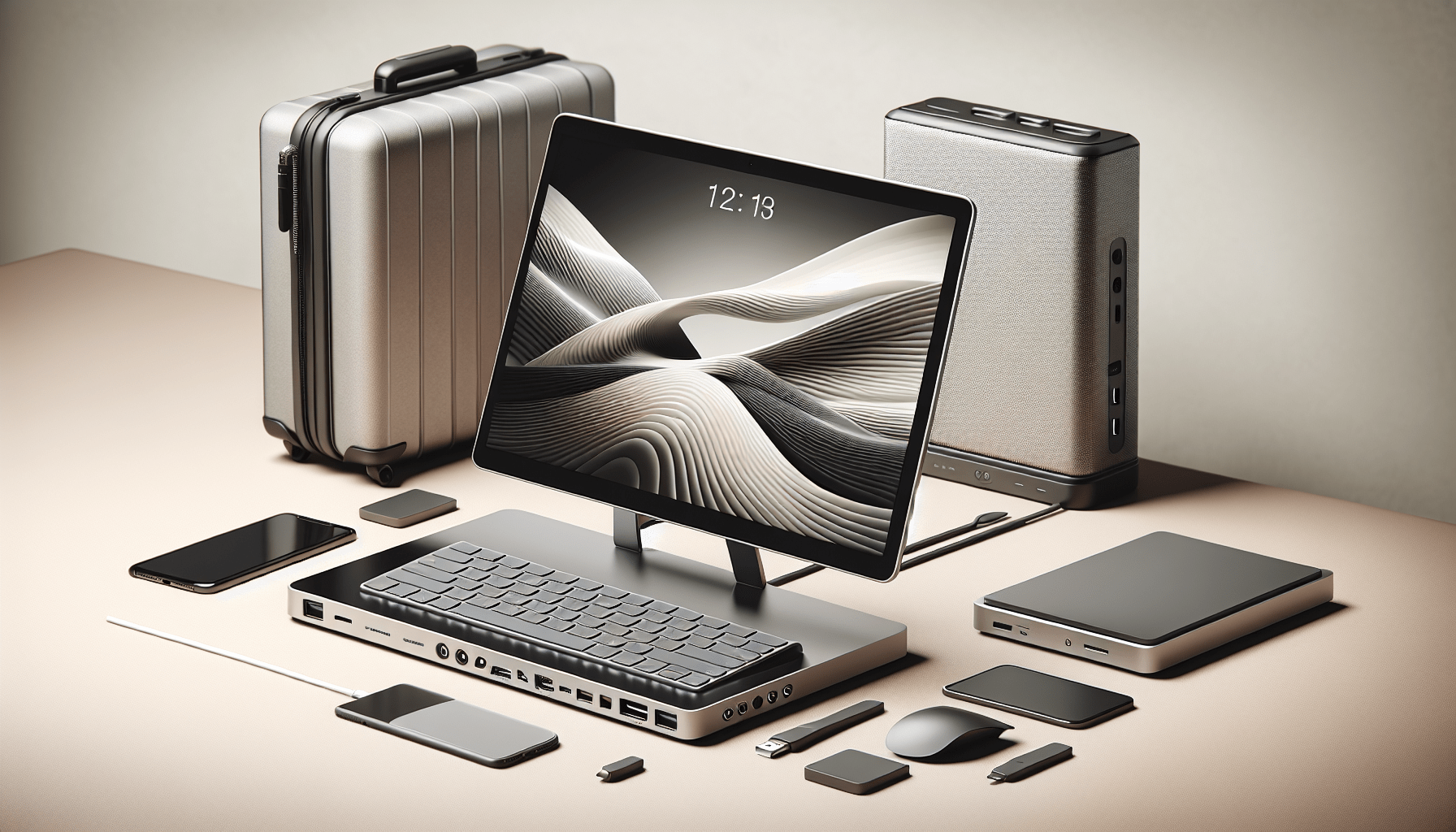
The Perfect Travel Setup: Combining Docking Stations & Portable Monitors
Combining docking stations and portable monitors could refine our travel setup into a hub of productivity and convenience. Imagine this: a lightweight docking station provides multiple ports for peripheral needs, while a portable monitor transforms our laptop into an expansive workstation no matter where we are. This way, whether we’re traveling for leisure or work, we can achieve more without sacrificing the nimbleness that travel often demands.
Seamless Connectivity
The synergy between these two devices cannot be understated. Whether it’s through a USB-C port or Thunderbolt 3 connection, they ensure our tech environment remains tethered and efficient. Ensuring compatibility between our docking station and portable monitor secures a hassle-free setup with minimal wires—mirroring the efficiency we seek when at our home or work desk.
Ideal Use Cases
We might be torn trying to see where exactly these gadgets fit within our travel routine. Here’s a sneak peek at real-world applications:
- Business Trips: A portable solution for on-the-go presentations or access to essential documents during conferences.
- Remote Work: Balances the convenience of working from a café or park with productivity levels akin to a formal office setup.
- Creative Projects: Allows for diversified screen space, juggling design software, editing tools, or even continuous email checks without compromising screen space.
- Entertainment on the Go: Can double as a personal entertainment system for movie nights during long flights or layovers.
Setting it All Up: Practical Tips
Amidst all the travel excitement, transitioning our tech setup should be a seamless endeavor. Here’s how we can efficiently integrate docking stations and portable monitors into our travel routine:
Packing Efficiently
Packing these devices might sound like a looming logistics challenge, but there’s beauty in simplicity. Using protective sleeves, pouches, or even designated compartments within our backpacks can keep them secure without contributing to unnecessary weight. Consider rolling cables for space efficiency and keeping them in ziplock bags to prevent tangling.
Cable Management
Let’s face it: Cables can be notorious for their propensity to cause chaos. With our docking stations and portable monitors, this must be proactively managed. Label each cable and have them neatly tucked in cable ties or organizers. Velcro strips offer convenience with their easy adjustability and reusability.
Regular Checks
Technology is only as effective as its consistency. Ensure all equipment is diligently tested before long trips to prevent last-minute hiccups. These checkups ensure that firmware and software are updated, eliminating possible compatibility issues mid-travel.
Why This Setup Matters
In embracing the portability and convenience of docking stations and portable monitors, we’re choosing life-enriching travel solutions. Productivity doesn’t need to stand in stark contrast to adventure. This setup thrives in merging these two often competing elements, allowing our laptops to shift effortlessly from itinerant globetrotters to polished professionals.
These tech companions can redefine the way we navigate the world. We can create efficient workspaces, bridge time zones, and consistently stay connected, all while experiencing new cities and cultures with joyous vitality. The ‘distance’ becomes less of an obstacle and more of an opportunity—a promise of what we can achieve when properly equipped and inspired.
In summation, it’s clear: Docking stations and portable monitors are more than simple tech gadgets. They’re enablers—an integral part of our travels that promises efficacy and enjoyment, no matter where we wander next.
Docking Station Intelligence
The standards are confusing by design. These three panels decode what manufacturers won’t explain clearly. Applicable to every docking station.
The USB-C Confusion Matrix
The USB-C connector is the single greatest source of buyer confusion in docking stations. The physical plug looks identical whether it carries USB 2.0 at 480 Mbps or Thunderbolt 5 at 120 Gbps — a 250x difference in capability hidden behind the same shape. Manufacturers exploit this by labeling everything "USB-C compatible" without specifying which protocol runs through it. Two docks can look identical on the outside and behave completely differently once you plug them in.
The hierarchy matters because it determines everything: how many monitors your dock can drive, how fast files transfer, whether your laptop charges while docked, and whether you need third-party drivers. Here is the real capability ladder, from slowest to fastest:
The practical takeaway: if your laptop has Thunderbolt 4, buy a Thunderbolt dock. If it only has generic USB-C, verify whether it supports DisplayPort Alt Mode before buying anything with multi-monitor claims. Our buying guide walks through verification steps for every major laptop brand.
Power Delivery: What the Watts Mean
Power Delivery (PD) determines whether your docking station can charge your laptop while you work, or whether you need a separate charger cluttering your desk. The math is simple but rarely explained: your laptop draws a specific wattage under load, and the dock must match or exceed it. If the dock delivers less than your laptop needs, the battery slowly drains even while plugged in — defeating the purpose of a docking station entirely.
Most ultrabooks need 45–65W. Standard business laptops need 65–100W. Gaming and workstation laptops can demand 100–140W or more. The dock’s advertised PD wattage is the maximum it can deliver to your laptop — but this drops if you charge other devices (phones, tablets) through the dock simultaneously. Always leave a 15–20W margin above your laptop’s requirement.
Check your laptop’s original charger wattage — that’s your baseline. Our FAQ covers how to find this for every major brand.
Native Display vs DisplayLink: The Hidden Factor
This is the decision most buyers don’t know they’re making. When a docking station outputs video to your monitors, it uses one of two fundamentally different methods: native (the dock passes your laptop’s GPU signal directly to the monitor) or DisplayLink (the dock compresses video over USB and a software driver renders it). The difference is invisible in marketing materials but profoundly affects your daily experience.
Native output through DisplayPort Alt Mode or Thunderbolt uses your laptop’s actual graphics hardware. There is zero added latency, full DRM support for streaming services, no CPU overhead, and no driver to install. DisplayLink, by contrast, adds 5–15ms of latency (noticeable in video calls and cursor movement), blocks DRM content on connected monitors (Netflix, Disney+ show black screens), consumes 3–8% of your CPU constantly, and requires a driver that Apple’s macOS security updates occasionally break.
DisplayLink exists for one reason: Apple Silicon base chips (M1, M2, M3) can only drive one external display natively. If you need two or more monitors on a base MacBook Air or 13” MacBook Pro, DisplayLink is your only option. For everyone else — Windows users, Mac Pro/Max chip users, Intel/AMD laptops — native is always the better choice.
Native (Alt Mode / Thunderbolt)
DisplayLink (USB compression)
The bottom line: if your laptop supports native multi-display output, always choose a native dock. DisplayLink is a workaround, not an upgrade. See our glossary for detailed definitions.
COMMAND CENTERCOMMAND CENTER
Six tools that decode the confusion manufacturers create. Port protocols, power budgets, display configurations, compatibility, desk planning, and future-proofing. Full buying guide →
Port Protocol DecoderWhat does your connection type actually support? Glossary
Power Delivery CalculatorCan this dock keep your laptop charged?
Display Configuration PlannerCan your dock push enough pixels?
Laptop-to-Dock CompatibilityWill this dock work with YOUR laptop?
Desk Setup ArchitectWhat ports do you actually need?
Select everything you need to connect: